Within UFO Research Deaths
When Does Gravity Research Become an Antigravity Claim?
Legitimate research involving gravity or superconductors does not by itself demonstrate gravity cancellation or a working antigravity device.
On this page
- What legitimate gravity research can establish
- Where stronger antigravity claims begin
- Why technological proof requires more evidence
Page outline Jump by section
Introduction
Research on gravity, superconductors and unconventional propulsion can be scientifically legitimate without establishing “antigravity”. That distinction matters in discussions of UFO technology and alleged suppression of researchers, because the strongest versions of those narratives often assume that unusual theoretical work had already crossed the much larger evidential gap to a functioning gravity-control device.
Established gravitational physics does allow unfamiliar effects. General relativity predicts curved spacetime, gravitational waves and frame-dragging; physicists continue to test whether gravity behaves exactly as Einstein’s theory predicts; and experiments can legitimately ask whether unusual states of matter reveal tiny departures from known theory. But none of that is equivalent to demonstrating that gravity can be screened, cancelled or reversed on demand. Modern tests instead place increasingly stringent limits on departures from general relativity and the equivalence principle. The critical question is therefore not whether a researcher studied an unconventional gravitational mechanism, but whether the claimed mechanism produced a reproducible force that survives controls for electromagnetic, thermal, mechanical and instrumental effects.[APS Journals]journals.aps.orgAPS JournalsMission: Final Results of the Test of the Equivalence Principle | Phys. Rev. Lett.September 14, 2022…
What legitimate gravity research can establish
A useful starting point is that gravity research routinely examines effects that would once have sounded extraordinary. General relativity predicts that a rotating body drags spacetime slightly around with it, an effect known as frame-dragging. NASA and Stanford’s Gravity Probe B mission measured this phenomenon using precision gyroscopes in Earth orbit, obtaining a frame-dragging result consistent, within its experimental uncertainty, with Einstein’s prediction. Such an experiment is genuinely about a coupling between rotation and gravity, but it does not create a propulsion field or weaken Earth’s gravitational pull.[NASA]nasa.govWhat is Gravity Probe B?What is Gravity Probe B? - NASAJune 12, 2020…
The same distinction applies to equivalence-principle research. The weak equivalence principle says, in practical terms, that freely falling bodies respond to gravity in the same way regardless of their composition. The MICROSCOPE satellite compared titanium and platinum test masses and found no violation, constraining their relative differential acceleration to roughly the 10−15 level. Rather than revealing an accessible way to alter gravitational mass, the result severely restricts many theories that would predict composition-dependent gravitational behaviour.[APS Journals]journals.aps.orgAPS JournalsMission: Final Results of the Test of the Equivalence Principle | Phys. Rev. Lett.September 14, 2022…
Antimatter provides an especially clear example of the difference between an interesting gravity question and an antigravity result. It was scientifically legitimate to ask whether antihydrogen would fall downwards or experience repulsive gravity. CERN’s ALPHA-g experiment finally observed neutral antihydrogen under Earth’s gravity and found its acceleration directed towards Earth, consistent within uncertainty with ordinary gravitational attraction. The experiment specifically ruled out the simple idea that antimatter falls upwards with a gravitational acceleration of approximately −g.[Nature]nature.comObservation of the effect of gravity on the motion of antimatter | NatureObservation of the effect of gravity on the motion of antimatter | NatureSeptember 27, 2023…
These examples show why the word “antigravity” can be misleading. A laboratory may study gravitomagnetism, equivalence-principle violations or the behaviour of exotic matter under gravity without possessing any method for cancelling gravity. Even discovering a tiny deviation from general relativity would not automatically yield practical propulsion: the magnitude, controllability, energy requirement and scalability of the effect would all have to be demonstrated separately.
Superconductors are where the boundary becomes especially important
Superconductors occupy a prominent place in antigravity narratives because they exhibit genuinely remarkable macroscopic quantum behaviour. Electrical resistance can vanish, magnetic flux can be expelled or quantised, and superconducting currents can persist for long periods. Those properties make superconductors reasonable systems in which to investigate extremely small couplings between quantum matter, electromagnetism and gravity. They do not, by themselves, imply gravity shielding.
This distinction is particularly relevant to the work of Ning Li and Douglas Torr. Their early papers examined theoretical gravitational effects in superconductors. A 1991 paper in Physical Review D analysed how gravitomagnetic and electromagnetic fields might behave in a pure superconductor, while a 1992 Physical Review B paper considered gravitational contributions to magnetic attenuation. Whatever one thinks of the models, publication of such theoretical work is not evidence that a laboratory gravity shield existed. The papers addressed possible field couplings within formal models; they did not report a propulsion craft or a macroscopic cancellation of Earth’s gravitational field.[APS Journals]journals.aps.orgPhys Rev D.43.457APS JournalsEffects of a gravitomagnetic field on pure superconductors | Phys. Rev. DJanuary 15, 1991…
That point is easily lost when later accounts summarise the work simply as “antigravity research”. In scientific terms, there is a large progression from proposing a coupling, to predicting a measurable anomaly, to detecting it, to independent replication, and finally to engineering a controllable technology. Moving directly from the first or second stage to the last changes the evidential status of the story.
Li herself later co-authored an experimental test using bulk yttrium-barium-copper-oxide, or YBCO, superconductors. The experiment was motivated in part by reports of gravitational anomalies around superconducting material. Using a sensitive gravimeter, however, the researchers found changes in acceleration smaller than two parts in 108 of normal terrestrial gravity under the tested static conditions. The experiment therefore established a limit rather than demonstrating macroscopic gravitational shielding.[ScienceDirect]sciencedirect.comOpen source on sciencedirect.com.
For discussions linking Li’s research to UFO propulsion or to claims that revolutionary work had to be hidden, this is an important evidential constraint. Her scientific record shows serious engagement with unconventional gravity questions. It does not publicly establish that she had achieved operational antigravity.
Where stronger antigravity claims begin
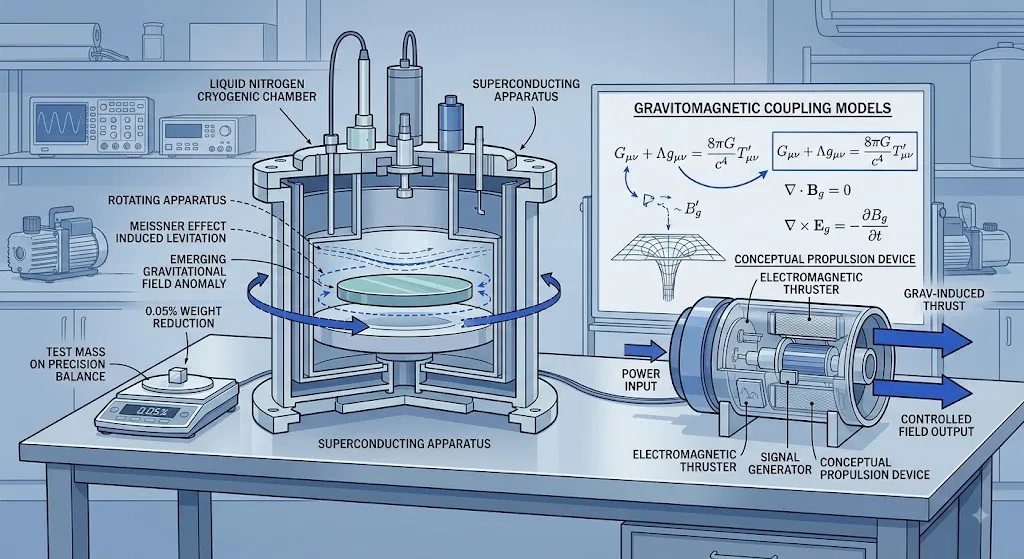
The dividing line becomes clearer in the case of Eugene Podkletnov’s superconducting experiments. In a 1992 Physica C paper with R. Nieminen, Podkletnov reported that a small test mass positioned above a levitating YBCO superconductor appeared to lose approximately 0.05–0.3 per cent of its weight. The authors suggested that an unusual superconducting state might somehow modify gravitational interaction. A later preprint described much larger reported reductions, reaching roughly 2 per cent under particular rotating and electromagnetic conditions.[ScienceDirect]sciencedirect.comOpen source on sciencedirect.com.
If those effects were robust, they would be extraordinary. A repeatable one- or two-per-cent reduction in gravitational weight caused by a compact laboratory apparatus would not be a minor refinement of gravitational theory. It would require a major explanation and would immediately invite engineering tests.
That is precisely why replication matters more than the novelty of the original report. A 2003 experiment by George Hathaway, Brian Cleveland and Yicheng Bao attempted to reproduce the alleged effect using a rotating superconducting disc and radio-frequency fields, drawing on Podkletnov’s published descriptions and additional communications. The researchers reported no gravity-like force within the sensitivity of their apparatus.[ScienceDirect]sciencedirect.comOpen source on sciencedirect.com.
The null result does not logically prove that every conceivable version of Podkletnov’s experimental arrangement must fail. Replication can be complicated when claimed effects depend on difficult material fabrication, cryogenic conditions or poorly characterised operating regimes. But an extraordinary mechanism cannot become established technology through such qualifications. If an effect is claimed to be large enough for propulsion, proponents ultimately need to specify conditions precisely enough for independent laboratories to reproduce it.
A 2022 preprint by A. V. Fetisov reported small apparent weight changes near YBCO material and described them as new evidence related to the Podkletnov effect. The experimental configuration differed significantly from the original: the material was not superconducting and was not rotating, and the authors proposed a different interpretation. Such a report is relevant to continuing investigation, but a preprint reporting another anomalous weight measurement is not equivalent to broad independent confirmation of gravitational shielding. The central replication problem therefore remains.[arXiv]arxiv.orgarXiv New experimental evidence for Podkletnov effectarXiv New experimental evidence for Podkletnov effect
A gravitational anomaly is not automatically gravity control
The term “gravity shielding” carries a stronger implication than merely observing a balance reading that changes when an apparatus is activated. A weight measurement can be affected by several ordinary forces that are enormously stronger than gravity at laboratory scales.
This is particularly troublesome around superconducting apparatus. Such experiments may involve strong magnetic fields, rapidly changing currents, cryogenic fluids, vibration, rotating machinery, high voltages and thermal gradients. An apparent reduction in measured weight can therefore arise from magnetic coupling to supposedly non-magnetic components, mechanical vibration transmitted to a balance, gas movement, electrostatic forces, buoyancy changes or shifts in the apparatus itself. Demonstrating genuine gravitational modification requires isolating the measured object from these alternatives and showing that the effect follows properties expected of gravity rather than of the laboratory hardware.
The ALPHA-g antihydrogen experiment illustrates how demanding that separation can be. Gravity is so weak relative to electromagnetism that minute stray electric or magnetic fields can overwhelm the gravitational force on antimatter particles. The collaboration therefore used electrically neutral antihydrogen, carefully characterised magnetic confinement and compared measured escape patterns with simulations for attractive, absent and repulsive gravity. That is the sort of discriminating methodology required when an experiment is supposed to identify gravity itself rather than an unexplained force.[Nature]nature.comObservation of the effect of gravity on the motion of antimatter | NatureObservation of the effect of gravity on the motion of antimatter | NatureSeptember 27, 2023…
NASA encountered a similar problem in evaluating claimed “mechanical antigravity” devices. A technical memorandum drawing on the agency’s Breakthrough Propulsion Physics programme warned that oscillating masses and gyroscopes can appear to generate net thrust because of differential friction or confusion between torque and linear force. NASA’s recommendation was not to dismiss every unconventional claim in advance, but to demand clear minimum experimental thresholds capable of distinguishing genuine propulsion from artefacts.[NASA Technical Reports Server]ntrs.nasa.govTechnical Reports Server Responding to Mechanical AntigravityTechnical Reports Server Responding to Mechanical Antigravity
That principle applies directly to alleged gravitational technologies. A moving pointer, a changed scale reading or an unexplained acceleration is the beginning of an investigation, not the final identification of a new force.
General relativity contains unusual gravity without providing a gravity switch
Another common source of confusion is the fact that general relativity itself permits gravitational phenomena far removed from Newton’s simple picture of attraction between masses. Rotating bodies generate gravitomagnetic effects analogous in some mathematical respects to magnetism; gravitational waves carry disturbances in spacetime; cosmological models can contain accelerated expansion; and speculative spacetime geometries can be written down mathematically.
None of these observations supplies a known laboratory mechanism for placing a screen between an object and Earth and thereby blocking gravity. The familiar electromagnetic analogy is particularly dangerous here. A conductor can rearrange electric charge so that an electrostatic field is screened, and superconductors have distinctive magnetic behaviour. Gravity in general relativity is not another electromagnetic field for which an analogous shielding material has been demonstrated.
Gravitomagnetism offers a good illustration. Frame-dragging is real: Gravity Probe B measured an effect of the magnitude predicted for Earth’s rotation. Yet the effect is extremely small, not a strong artificial field produced by an ordinary rotating object. Some speculative superconductivity papers have proposed greatly enhanced gravitomagnetic phenomena, including work by Martin Tajmar and Clovis de Matos. Those authors themselves noted that earlier superconducting gravitational anomalies had not been independently reproduced and that proposed explanations rested on unsettled assumptions.[NASA]nasa.govResults and ImplicationsResults and Implications - NASA…
The existence of a theoretically named field therefore proves little about engineering feasibility. The meaningful questions are quantitative: how strong is it, what source produces it, how much energy is required, does it survive independent measurement, and can it exert a controllable force on external objects?
Why modern precision tests raise the evidential bar
Antigravity claims do not exist in a vacuum. They sit alongside an increasingly dense network of high-precision experiments testing gravity across very different scales.
MICROSCOPE found no composition-dependent violation of free fall down to roughly parts in 1015. ALPHA-g observed antihydrogen accelerating towards Earth rather than displaying simple gravitational repulsion. Gravity Probe B detected frame-dragging at approximately the strength predicted by general relativity. Gravitational-wave observations provide additional strong-field tests: in July 2026 the LIGO–Virgo–KAGRA collaboration reported that its largest combined set of tested compact-object merger signals remained consistent with general relativity, with tighter bounds on possible deviations.[aps.org]journals.aps.orgAPS JournalsMission: Final Results of the Test of the Equivalence Principle | Phys. Rev. Lett.September 14, 2022…
None of those experiments rules out every conceivable new interaction. Physics still lacks a complete quantum theory of gravity, and carefully designed searches for deviations remain scientifically worthwhile. But the accumulated evidence changes the burden of proof. A proposed laboratory gravity-control effect must either fit within the tightly constrained behaviour already observed or identify a new regime in which the effect appears without contradicting those tests.
That is why a claimed one-per-cent “gravity reduction” is not merely another small anomaly. In experimental terms, one per cent is enormous compared with the precision at which some foundational gravitational principles have been verified. A real effect of that scale, if controllable and reproducible, should usually produce unmistakable signals in well-isolated experiments.
What would count as technological proof?
For the UFO-and-antigravity suppression narrative, the decisive evidential leap is often left implicit. A scientist may have written about gravity modification, obtained funding, conducted classified work or reported an anomaly. None of these establishes that the scientist possessed a usable propulsion technology.
A credible demonstration of engineered antigravity would need substantially more. At minimum, independent investigators would need a clearly specified apparatus; blinded or otherwise well-controlled measurements separating gravitational effects from electromagnetic and mechanical forces; repeatability across multiple laboratories; scaling behaviour matching a coherent physical model; and a measurable reaction on external test masses or trajectories. If the device were claimed to provide propulsion, it would also need to demonstrate sustained net acceleration under conditions excluding ordinary momentum exchange.
Energy accounting would matter as well. A technology cannot be inferred merely because mathematical solutions of a gravitational theory permit unusual spacetime configurations. The physical source required to produce the configuration must itself be attainable. NASA’s Breakthrough Propulsion Physics programme explicitly explored speculative possibilities such as gravity–electromagnetism coupling, warp concepts and other unconventional mechanisms, while stressing the need to identify credible experiments rather than assuming that mathematically interesting possibilities were near-term engineering solutions.[NASA Technical Reports Server]ntrs.nasa.govTechnical Reports Server NASA Breakthrough Propulsion Physics ProgramTechnical Reports Server NASA Breakthrough Propulsion Physics Program
Reproducibility is equally decisive. A revolutionary device need not initially be understood theoretically, but its observable behaviour must be transferable. If a claimed force disappears when a different group rebuilds the apparatus, the evidence has not reached the level required to overturn gravitational physics.
The distinction that matters for suppression claims
Within accounts of allegedly suspicious deaths or disappearances of UFO and antigravity researchers, there is a recurring temptation to treat proximity to unconventional gravitational research as evidence of possession of a breakthrough. Scientifically, those are very different propositions.
Ning Li’s published record shows serious theoretical and experimental research on possible gravitational effects in superconductors. Podkletnov published a remarkable gravity-shielding claim. NASA funded and examined speculative propulsion physics. Researchers have explored gravitomagnetism and other possible couplings. These facts establish that unconventional gravitational research has existed within legitimate scientific and engineering institutions.[aps.org]journals.aps.orgAPS JournalsGravitational effects on the magnetic attenuation of superconductors | Phys. Rev. B…
They do not establish that any of those lines of work produced a functioning gravity-cancellation technology. In the most prominent superconducting case, published independent replication failed to detect the claimed force; Li’s own static YBCO experiment instead set a stringent upper limit under the conditions tested. Meanwhile, precision gravitational experiments continue to agree closely with conventional theory.[ScienceDirect]sciencedirect.comOpen source on sciencedirect.com.
That evidential distinction is central when evaluating later claims of suppression. Evidence that a scientist researched an unconventional mechanism can support the statement that the person worked on an unusual or potentially important subject. It cannot, without additional experimental documentation, support the stronger premise that the scientist had already discovered revolutionary propulsion worth concealing.
The practical threshold
The most reliable way to judge an antigravity claim is therefore to ask where it sits on an evidence ladder. A theoretical coupling is a research hypothesis. A single anomalous measurement is an experimental clue. A replicated anomaly is evidence of a real phenomenon. A mechanism that survives competing explanations becomes a candidate extension of physics. Only after controllable, repeatable scaling and demonstrated net force does the discussion begin to resemble propulsion technology.
Superconductors, antimatter, frame-dragging and quantum-gravity research are all legitimate parts of modern physics. Their existence keeps open the possibility that nature contains gravitational behaviour not yet fully understood. What the current public evidence does not provide is a reproducible device that screens Earth’s gravity or generates the kind of controllable field commonly implied by “antigravity” in UFO narratives.
For that reason, claims about suppressed antigravity breakthroughs require two separate evidential demonstrations rather than one: evidence that suppression or wrongdoing occurred, and independent evidence that the underlying technology actually worked. Established gravitational physics does not make new discoveries impossible. It does, however, make clear what a revolutionary claim must overcome: not institutional scepticism alone, but decades of increasingly precise experimental tests and the absence so far of a reproducible gravity-cancellation effect.
Amazon book picks
Further Reading
Books and field guides related to When Does Gravity Research Become an Antigravity Claim?. Use these as the next step if you want deeper reading beyond the article.
Gravity: How the Weakest Force in the Universe Shaped Our Lives
A history of gravity, and a study of its importance and relevance to our lives, as well as its influence on other areas of science. Physi...
General Relativity: The Essentials
A straightforward introduction to General Relativity, explaining the physical, philosophical and mathematical ideas it is built on.
The Antigravity Enigma: Fiction, Fringe Science, and Modern P...
From magic carpets to hoverboards and space drives, the human imagination has always seen antigravity as the ultimate aspirational symbol...
Gravity: An Introduction to Einstein's General Relativity
Einstein's theory of general relativity is a cornerstone of modern physics. It also touches upon a wealth of topics that students find fa...
eBay marketplace picks
Marketplace Samples
Live-tested eBay searches with available results related to this page.
Selected fromantigravity poster oneBay.co.uk.



Endnotes
1.
Source: journals.aps.org
Link:https://journals.aps.org/prl/abstract/10.1103/PhysRevLett.129.121102
Source snippet
APS JournalsMission: Final Results of the Test of the Equivalence Principle | Phys. Rev. Lett.September 14, 2022...
Published: September 14, 2022
2.
Source: ligo.org
Link:https://ligo.org/science-summaries/o4b_tgr/
Source snippet
Testing general relativity with the latest and loudest compact binary merger observations – LSC – LIGO Scientific Collaboration...
3.
Source: nasa.gov
Title: What is Gravity Probe B?
Link:https://www.nasa.gov/image-article/what-gravity-probe-b/
Source snippet
What is Gravity Probe B? - NASAJune 12, 2020...
Published: June 12, 2020
4.
Source: nasa.gov
Title: Results and Implications
Link:https://www.nasa.gov/image-article/results-implications/
Source snippet
Results and Implications - NASA...
5.
Source: aps.org
Link:https://www.aps.org/about/news/2022/09/general-relativitys-weak-equivalence-principle
Source snippet
American Physical SocietyMICROSCOPE Mission Present's Most Precise Test of General Relativity's Weak Equivalence Principle | American Phy...
6.
Source: nature.com
Title: Observation of the effect of gravity on the motion of antimatter | Nature
Link:https://www.nature.com/articles/s41586-023-06527-1
Source snippet
Observation of the effect of gravity on the motion of antimatter | NatureSeptember 27, 2023...
Published: September 27, 2023
7.
Source: physics.aps.org
Link:https://physics.aps.org/articles/v16/167
Source snippet
Physics - Antimatter Feels Gravity Just like Matter...
8.
Source: journals.aps.org
Title: Phys Rev D.43.457
Link:https://journals.aps.org/prd/abstract/10.1103/PhysRevD.43.457
Source snippet
APS JournalsEffects of a gravitomagnetic field on pure superconductors | Phys. Rev. DJanuary 15, 1991...
Published: January 15, 1991
9.
Source: journals.aps.org
Link:https://journals.aps.org/prb/abstract/10.1103/PhysRevB.46.5489
Source snippet
APS JournalsGravitational effects on the magnetic attenuation of superconductors | Phys. Rev. B...
10.
Source: sciencedirect.com
Link:https://www.sciencedirect.com/science/article/pii/S0921453497014627
11.
Source: sciencedirect.com
Link:https://www.sciencedirect.com/science/article/pii/092145349290055H
12.
Source: arxiv.org
Link:https://arxiv.org/abs/cond-mat/9701074
13.
Source: sciencedirect.com
Link:https://www.sciencedirect.com/science/article/pii/S0921453402022840
14.
Source: arxiv.org
Title: arXiv New experimental evidence for Podkletnov effect
Link:https://arxiv.org/abs/2209.03332
15.
Source: ntrs.nasa.gov
Title: Technical Reports Server Responding to Mechanical Antigravity
Link:https://ntrs.nasa.gov/search.jsp?R=20070004897
16.
Source: arxiv.org
Link:https://arxiv.org/abs/gr-qc/0607086
17.
Source: ntrs.nasa.gov
Title: Technical Reports Server NASA Breakthrough Propulsion Physics Program
Link:https://ntrs.nasa.gov/archive/nasa/casi.ntrs.nasa.gov/19980201240.pdf
18.
Source: ntrs.nasa.gov
Link:https://ntrs.nasa.gov/search.jsp?R=19990023211
19.
Source: journals.aps.org
Title: hsyt nv2n
Link:https://journals.aps.org/prb/accepted/10.1103/hsyt-nv2n
20.
Source: physics.aps.org
Link:https://physics.aps.org/articles/v19/79
21.
Source: meetings-archive.aps.org
Title: mar u31
Link:https://meetings-archive.aps.org/smt/2026/mar-u31/15/
22.
Source: dcc.ligo.org
Link:https://dcc.ligo.org/LIGO-P2500066/public
23.
Source: physics.aps.org
Link:https://physics.aps.org/articles/v19/s14
24.
Source: nature.com
Link:https://www.nature.com/articles/s41467-025-65085-4
25.
Source: science.nasa.gov
Title: general relativity and the nature of spacetime
Link:https://science.nasa.gov/astrophysics/programs/physics-of-the-cosmos/general-relativity-and-the-nature-of-spacetime/
26.
Source: journals.aps.org
Link:https://journals.aps.org/prl/abstract/10.1103/PhysRevLett.134.181402
27.
Source: nature.com
Link:https://www.nature.com/articles/s41598-024-82092-5
28.
Source: meetings-archive.aps.org
Link:https://meetings-archive.aps.org/dpp/2024/zo08/6/
29.
Source: meetings-archive.aps.org
Link:https://meetings-archive.aps.org/dnp/2024/d01/3/
30.
Source: meetings.aps.org
Link:https://meetings.aps.org/Meeting/DNP24/Session/D01.3
31.
Source: meetings.aps.org
Link:https://meetings.aps.org/Meeting/DAMOP24/Session/Y03.1
32.
Source: meetings-archive.aps.org
Link:https://meetings-archive.aps.org/damop/2024/y03/1/
33.
Source: nature.com
Title: Gravity is attractive | Nature Physics
Link:https://www.nature.com/articles/s41567-023-02292-0
34.
Source: nature.com
Title: Daily briefing: Grape DNA reveals the true origins of wine
Link:https://www.nature.com/articles/d41586-023-03092-5
35.
Source: nature.com
Link:https://www.nature.com/nature/volumes/621/issues/7980
36.
Source: nature.com
Title: Free-falling antihydrogen reveals the effect of gravity on antimatter
Link:https://www.nature.com/articles/d41586-023-02930-w
37.
Source: nature.com
Title: Antimatter falls down, not up: CERN experiment confirms theory
Link:https://www.nature.com/articles/d41586-023-03043-0
38.
Source: science.nasa.gov
Title: gravity probe b
Link:https://science.nasa.gov/mission/gravity-probe-b/
39.
Source: journals.aps.org
Link:https://journals.aps.org/prd/abstract/10.1103/PhysRevD.107.023003
40.
Source: journals.aps.org
Link:https://journals.aps.org/prd/abstract/10.1103/PhysRevD.106.103025
41.
Source: news.stanford.edu
Title: campus curiosities
Link:https://news.stanford.edu/stories/2022/10/campus-curiosities
42.
Source: journals.aps.org
Link:https://journals.aps.org/prl/issues/129/12
43.
Source: aps.org
Title: New Results for MICROSCOPE Mission | American Physical Society
Link:https://www.aps.org/apsnews/2022/09/microscope-mission-general-relativity
44.
Source: physics.aps.org
Link:https://physics.aps.org/articles/v15/94
45.
Source: physics.aps.org
Link:https://physics.aps.org/articles/v15/95
46.
Source: journals.aps.org
Link:https://journals.aps.org/pra/abstract/10.1103/PhysRevA.105.022821
47.
Source: journals.aps.org
Link:https://journals.aps.org/pra/abstract/10.1103/PhysRevA.104.022822
48.
Source: nasa.gov
Title: Leonard Schiff and Birth of Gravity Probe B
Link:https://www.nasa.gov/image-article/leonard-schiff-birth-of-gravity-probe-b/
49.
Source: physics.aps.org
Link:https://physics.aps.org/articles/v12/s46
50.
Source: journals.aps.org
Link:https://journals.aps.org/prl/abstract/10.1103/PhysRevLett.121.261101
51.
Source: nature.com
Link:https://www.nature.com/articles/d41586-018-06023-x
52.
Source: journals.aps.org
Link:https://journals.aps.org/prd/abstract/10.1103/PhysRevD.98.042002
53.
Source: nasa.gov
Title: A Breakthrough Propulsion Architecture for Interstellar Precursor Missions
Link:https://www.nasa.gov/general/a-breakthrough-propulsion-architecture-for-interstellar-precursor-missions/
54.
Source: dcc.ligo.org
Link:https://dcc.ligo.org/LIGO-G1701305/public
55.
Source: nasa.gov
Title: A Breakthrough Propulsion Architecture for Interstellar Precursor Missions
Link:https://www.nasa.gov/general/a-breakthrough-propulsion-architecture-for-interstellar-precursor-missions-2/
56.
Source: meetings.aps.org
Link:https://meetings.aps.org/Meeting/FWS16/Event/286204
57.
Source: nature.com
Link:https://www.nature.com/articles/srep35879
58.
Source: nature.com
Link:https://www.nature.com/articles/srep34140
59.
Source: nature.com
Link:https://www.nature.com/articles/srep23424
60.
Source: nature.com
Link:https://www.nature.com/articles/srep15777
61.
Source: nature.com
Link:https://www.nature.com/articles/ncomms8820
62.
Source: nature.com
Link:https://www.nature.com/articles/srep09739
63.
Source: nature.com
Title: A moiré deflectometer for antimatter | Nature Communications
Link:https://www.nature.com/articles/ncomms5538
64.
Source: nature.com
Title: An experimental limit on the charge of antihydrogen | Nature Communications
Link:https://www.nature.com/articles/ncomms4955
65.
Source: nature.com
Title: Quantum rotor in nanostructured superconductors | Scientific Reports
Link:https://www.nature.com/articles/srep04542
66.
Source: journals.aps.org
Link:https://journals.aps.org/prl/abstract/10.1103/PhysRevLett.112.121102
67.
Source: nature.com
Link:https://www.nature.com/articles/ncomms2787
68.
Source: nature.com
Title: Lightning in superconductors | Scientific Reports
Link:https://www.nature.com/articles/srep00886
69.
Source: ilrs.gsfc.nasa.gov
Title: gp b general
Link:https://ilrs.gsfc.nasa.gov/missions/satellite_missions/past_missions/gp-b_general.html
70.
Source: einstein-new.stanford.edu
Link:https://einstein-new.stanford.edu/highlights/status1.html
71.
Source: news.stanford.edu
Title: s gravity probe b confirms two einstein theories
Link:https://news.stanford.edu/stories/2011/05/stanfords-gravity-probe-b-confirms-two-einstein-theories
72.
Source: einstein-new.stanford.edu
Title: results nasa hq
Link:https://einstein-new.stanford.edu/Media/results-nasa_hq.html
73.
Source: nature.com
Title: Trapped antihydrogen | Nature
Link:https://www.nature.com/articles/nature09610
74.
Source: physics.aps.org
Link:https://physics.aps.org/articles/v3/15
75.
Source: journals.aps.org
Title: Rev Mod Phys.82.109
Link:https://journals.aps.org/rmp/abstract/10.1103/RevModPhys.82.109
76.
Source: cosmicopia.gsfc.nasa.gov
Title: qa gp gr
Link:https://cosmicopia.gsfc.nasa.gov/qa_gp_gr.html
77.
Source: nature.com
Title: Antigravity has feet of clay: Nature News
Link:https://www.nature.com/news/2005/050124/full/news050124-8.html
78.
Source: ntrs.nasa.gov
Link:https://ntrs.nasa.gov/search.jsp?R=20040070788
79.
Source: news-archive.stanford.edu
Title: gpbshort 421
Link:https://news-archive.stanford.edu/news/2004/april21/gpbshort-421.html
80.
Source: imagine.gsfc.nasa.gov
Link:https://imagine.gsfc.nasa.gov/news/20apr04.html
81.
Source: ntrs.nasa.gov
Link:https://ntrs.nasa.gov/citations/20030067892
82.
Source: ecolloq.gsfc.nasa.gov
Link:https://ecolloq.gsfc.nasa.gov/archive/2003-Spring/announce.everitt.html
83.
Source: nature.com
Link:https://www.nature.com/articles/35024025
84.
Source: ntrs.nasa.gov
Link:https://ntrs.nasa.gov/search.jsp?R=19990047463
85.
Source: ntrs.nasa.gov
Link:https://ntrs.nasa.gov/citations/19980017317
86.
Source: sciencedirect.com
Title: Static test for a gravitational force coupled to type II YBCO superconductors
Link:https://www.sciencedirect.com/science/article/abs/pii/S0921453497014627
87.
Source: ntrs.nasa.gov
Link:https://ntrs.nasa.gov/citations/19970009634
88.
Source: sciencedirect.com
Title: Does a superconductor shield gravity?
Link:https://www.sciencedirect.com/science/article/pii/0921453496003401
89.
Source: ntrs.nasa.gov
Link:https://ntrs.nasa.gov/archive/nasa/casi.ntrs.nasa.gov/19960025450.pdf
90.
Source: sciencedirect.com
Title: Alternative explanation of “gravitational screening” experiments
Link:https://www.sciencedirect.com/science/article/abs/pii/0921453495004947
91.
Source: sciencedirect.com
Title: Alternative explanation of “gravitational screening” experiments
Link:https://www.sciencedirect.com/science/article/pii/0921453495004947
92.
Source: sciencedirect.com
Link:https://www.sciencedirect.com/science/article/abs/pii/092145349290055H
93.
Source: sciencedirect.com
Link:https://www.sciencedirect.com/science/article/pii/092145349290055H/pdf?md5=bfc751b87889117434dec5c029c2d522&pid=1-s2.0-092145349290055H-main.pdf
94.
Source: journals.aps.org
Link:https://journals.aps.org/prb/issues/46/9
95.
Source: ntrs.nasa.gov
Link:https://ntrs.nasa.gov/citations/19900010644
96.
Source: journals.aps.org
Link:https://journals.aps.org/prd/abstract/10.1103/PhysRevD.39.2825
97.
Source: ntrs.nasa.gov
Link:https://ntrs.nasa.gov/citations/19900028350
98.
Source: ntrs.nasa.gov
Link:https://ntrs.nasa.gov/citations/19800054809
99.
Source: meetings-archive.aps.org
Link:https://meetings-archive.aps.org/dpp/2024/np12/76/
100.
Source: meetings-archive.aps.org
Link:https://meetings-archive.aps.org/dpp/2012/bp8/2/
101.
Source: journals.aps.org
Link:https://journals.aps.org/prl/recent?journal%5B%5D=prl&page=3&sort=recent&toc_section%5B%5D=gravitation-and-astrophysics&type=article
102.
Source: journals.aps.org
Link:https://journals.aps.org/prl/recent?page=493
103.
Source: journals.aps.org
Link:https://journals.aps.org/prb/recent?ei=ntuwkjqa&page=8577
104.
Source: ntrs.nasa.gov
Link:https://ntrs.nasa.gov/search?q=Breakthrough+Propulsion+Physics
105.
Source: ntrs.nasa.gov
Link:https://ntrs.nasa.gov/search?q=Breakthrough+Propulsion+Physics+Workshop
106.
Source: ntrs.nasa.gov
Link:https://ntrs.nasa.gov/search?q=208400
107.
Source: nature.com
Link:https://www.nature.com/subjects/experimental-particle-physics/nature
108.
Source: sciencedirect.com
Title: Reverse Engineering Podkletnov’s Experiments
Link:https://www.sciencedirect.com/science/article/pii/S1875389211005803
109.
Source: ligo.org
Link:https://ligo.org/testing-general-relativity-with-observing-run-o4a-data/
110.
Source: ligo.org
Link:https://ligo.org/science-summaries/O4b_Cosmology/
111.
Source: dcc.ligo.org
Link:https://dcc.ligo.org/LIGO-G1701305-v1/public
112.
Source: ligo.org
Link:https://ligo.org/science-summaries/GW150914TestingGR/
113.
Source: ligo.org
Title: exceptional tests of general relativity with gw250114
Link:https://ligo.org/exceptional-tests-of-general-relativity-with-gw250114/
114.
Source: ligo.org
Link:https://ligo.org/science-summaries/O4a_TGR_Omnibus/
115.
Source: dcc-backup.ligo.org
Link:https://dcc-backup.ligo.org/LIGO-P2500066-v7/public
116.
Source: dcc-llo.ligo.org
Link:https://dcc-llo.ligo.org/LIGO-P2100275-v12/public
117.
Source: dcc-lho.ligo.org
Link:https://dcc-lho.ligo.org/LIGO-P2100275-v13/public
118.
Source: profiles.stanford.edu
Title: bradford parkinson
Link:https://profiles.stanford.edu/bradford-parkinson?tab=bio
119.
Source: einstein-new.stanford.edu
Link:https://einstein-new.stanford.edu/Media/
120.
Source: einstein-new.stanford.edu
Title: education index
Link:https://einstein-new.stanford.edu/RESOURCES/education-index.html
121.
Source: engineering100.stanford.edu
Title: the future firmly in sight
Link:https://engineering100.stanford.edu/stories/the-future-firmly-in-sight
122.
Source: einstein-new.stanford.edu
Title: spacetime index
Link:https://einstein-new.stanford.edu/SPACETIME/spacetime-index.html
123.
Source: hepl.stanford.edu
Title: about us
Link:https://hepl.stanford.edu/about-us
124.
Source: profiles.stanford.edu
Title: thomas langenstein
Link:https://profiles.stanford.edu/thomas-langenstein
125.
Source: en.ikwipedia.org
Title: Eugene Podkletnov
Link:https://en.ikwipedia.org/wiki/Eugene_Podkletnov
126.
Source: wired.com
Link:https://www.wired.com/1998/03/antigravity/
127.
Source: ligo.caltech.edu
Link:https://www.ligo.caltech.edu/page/about
128.
Source: ouci.dntb.gov.ua
Link:https://ouci.dntb.gov.ua/en/works/7nJwBNL7/
129.
Source: science.gov
Link:https://www.science.gov/topicpages/m/magnetic%2Blevitation%2Bexperiments
Additional References
130.
Source: youtube.com
Title: Measuring Spacetime Curvature
Link:https://www.youtube.com/watch?v=dNswvk3oP_k
Source snippet
This selection of videos directly illustrates the distinctions drawn in the article between fringe "antigravity" concepts and rigorous ex...
131.
Source: osti.gov
Link:https://www.osti.gov/pages/biblio/2481168
132.
Source: osti.gov
Link:https://www.osti.gov/pages/biblio/2563037
133.
Source: osti.gov
Link:https://www.osti.gov/biblio/1302997
134.
Source: osti.gov
Link:https://www.osti.gov/pages/biblio/2345973
135.
Source: osti.gov
Link:https://www.osti.gov/pages/biblio/2509524
136.
Source: osti.gov
Link:https://www.osti.gov/biblio/5896213
137.
Source: osti.gov
Link:https://www.osti.gov/biblio/2441082
138.
Source: osti.gov
Link:https://www.osti.gov/pages/biblio/2441082
139.
Source: osti.gov
Link:https://www.osti.gov/pages/biblio/1777281