Within Antigravity
Did Ning Li Ever Demonstrate Gravity Shielding?
Ning Li explored unconventional gravity-superconductor couplings, yet her published experiment established a tight limit rather than gravity shielding.
On this page
- What Li and Torr actually proposed in their theory papers
- What Li's YBCO gravimeter experiment tested
- Why published limits differ from an operational antigravity device
Page outline Jump by section
Introduction
Ning Li is frequently presented in UFO and antigravity narratives as a physicist who discovered that superconductors could shield gravity. The published record supports a much narrower conclusion. Li and physicist Douglas Torr developed theoretical models in the early 1990s exploring whether superconducting matter could couple electromagnetic and weak gravitational fields in unusual ways. Those papers were legitimate theoretical physics, but they did not report a working gravity shield.[APS Journals]journals.aps.orgPhys Rev D.43.457APS JournalsEffects of a gravitomagnetic field on pure superconductors | Phys. Rev. DJanuary 15, 1991…
More importantly, when Li later co-authored a direct experiment with type-II yttrium-barium-copper-oxide (YBCO) superconductors, the result was not a measurable reduction of gravity. The experiment found any change in local gravitational acceleration to be smaller than 2 parts in 100 million of ordinary gravity. The paper explicitly described this as a new limit on the proposed coupling.[ScienceDirect]sciencedirect.comStatic test for a gravitational force coupled to type II YBCO superconductors - ScienceDirectAugust 1, 1997…
That distinction — theoretical coupling versus demonstrated gravity control — is the central evidence gap in the Ning Li story.
What Li and Torr actually proposed
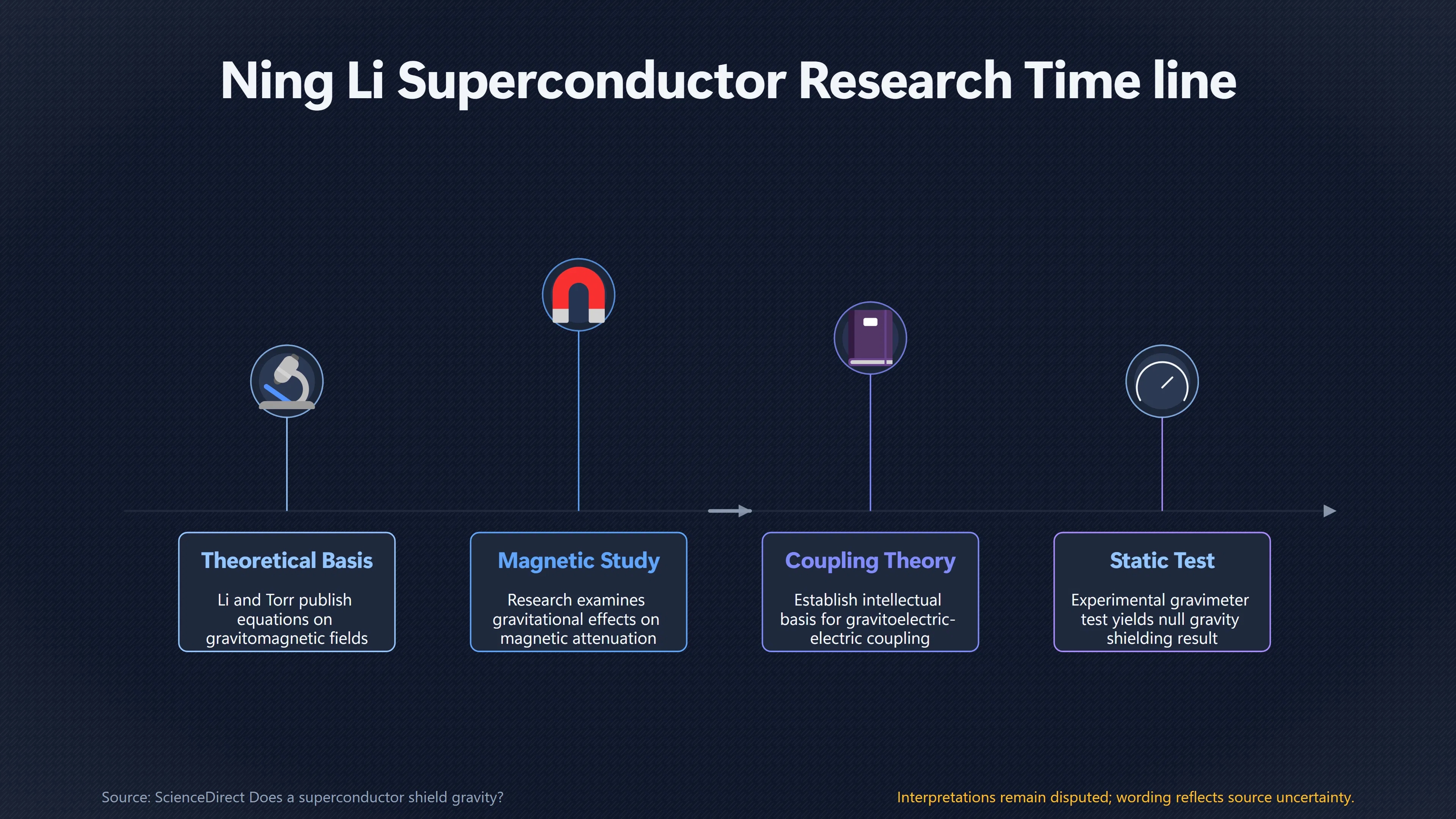
Li and Torr’s early work belongs to a line of research sometimes called gravitoelectromagnetism. In the weak-field, slow-motion approximation to general relativity, some gravitational equations can be written in a form resembling Maxwell’s equations for electricity and magnetism. This introduces quantities conventionally described as gravitoelectric and gravitomagnetic fields. The terminology can sound like an engineering recipe for antigravity, but the analogy does not mean ordinary magnetic fields become interchangeable with gravity.
Their 1991 Physical Review D paper, “Effects of a gravitomagnetic field on pure superconductors”, investigated theoretically what would happen to magnetic and gravitomagnetic fields inside an idealised pure superconductor. Their equations predicted small induced perturbations and an exponential attenuation of a particular combination of fields over a characteristic penetration distance. The paper was a theoretical calculation; its abstract reports no experimental production of an anomalously strong gravitational field.[APS Journals]journals.aps.orgPhys Rev D.43.457APS JournalsEffects of a gravitomagnetic field on pure superconductors | Phys. Rev. DJanuary 15, 1991…
In 1992, Li and Torr extended the treatment in Physical Review B. Their paper, “Gravitational effects on the magnetic attenuation of superconductors”, examined whether gravitational terms might affect the familiar electromagnetic properties of an ideal superconductor. Their conclusion was cautiously phrased: the calculation suggested that gravitational effects might be relevant to understanding superconductivity. It did not report gravity shielding, weight loss or propulsion.[APS Journals]journals.aps.orgAPS JournalsGravitational effects on the magnetic attenuation of superconductors | Phys. Rev. B…
A further paper by Torr and Li, “Gravitoelectric-electric coupling via superconductivity”, appeared in Foundations of Physics Letters in 1993. Together, these publications established the intellectual basis for Li’s later association with “gravity control”: superconductivity was being considered as a macroscopic quantum state in which normally negligible gravity-electromagnetism couplings might conceivably become experimentally accessible.[Ouci]ouci.dntb.gov.uaOuci Gravitoelectric-electric coupling via superconductivityOuci Gravitoelectric-electric coupling via superconductivity
The important distinction is that a calculated coupling is not equivalent to gravitational shielding. Even if a theory predicts a non-zero gravitomagnetic response, an antigravity device would require several additional demonstrations: that the effect exists experimentally, that it is much larger than conventional gravitational expectations, that it can produce a controlled force on external matter, and that the effect survives tests excluding magnetic, mechanical, thermal and instrumental artefacts.
Li and Torr’s theoretical papers did not establish those steps.
The YBCO experiment produced a limit, not a gravity shield
The most revealing publication for evaluating claims about Li is therefore not one of the theoretical papers but the 1997 Physica C article “Static test for a gravitational force coupled to type II YBCO superconductors”. Li co-authored it with David Noever, Tony Robertson, Ron Koczor and Whitt Brantley. NASA’s Technical Reports Server preserves the bibliographic record and identifies it as work associated with Marshall Space Flight Center.[NASA Technical Reports Server]ntrs.nasa.govNASA Technical Reports ServerStatic Test for a Gravitational Force Coupled to Type 2 YBCO Superconductors - NASA Technical Reports Server…
The experiment was conducted against the backdrop of extraordinary claims involving another researcher, Eugene Podkletnov. Podkletnov and R. Nieminen had reported in 1992 that objects above a superconducting YBCO disc appeared to lose approximately 0.05–0.3 per cent of their weight. Later claims associated with rotating superconductors reached still larger percentages.[ScienceDirect]sciencedirect.comA possibility of gravitational force shielding by bulk YBa2Cu3O7−x superconductor - ScienceDirectDecember 10, 1992…
Li’s 1997 paper did not reproduce such a result.
Instead, bulk YBCO superconductors were stably levitated in a direct-current magnetic field while a sensitive gravimeter looked for a change in gravitational acceleration. The measured variation was less than 2 × 10⁻⁸ g — two parts in 100 million of normal gravitational acceleration. The authors therefore described the measurement as placing new limits on the strength and range of any proposed coupling between static superconductors and gravity.[ScienceDirect]sciencedirect.comStatic test for a gravitational force coupled to type II YBCO superconductors - ScienceDirectAugust 1, 1997…
The scale difference is striking. A claimed effect of 0.05 per cent corresponds to roughly 5 × 10⁻⁴ of ordinary weight. Li and colleagues constrained their static configuration below roughly 2 × 10⁻⁸ g. Those figures differ by about 25,000-fold.
The experiments were not identical — Podkletnov’s best-known claims involved rotation and other conditions absent from Li’s static test — so Li’s result cannot fairly be described as a complete replication and disproof of every rotating-superconductor claim. But it does establish something highly relevant to the question of whether Li herself demonstrated gravity shielding: her published gravimeter experiment did not detect it.
Why Podkletnov and Li are easily conflated
Part of the confusion comes from chronology. Li and Torr were already publishing theoretical work on superconductors and gravitomagnetic fields when Podkletnov’s experimental gravity-shielding claim appeared. Both lines of work involved superconductivity, YBCO became prominent in subsequent discussion, and both were eventually absorbed into popular accounts of gravity-control research.
But they are not the same evidential claim.
Podkletnov and Nieminen’s 1992 Physica C paper explicitly reported apparent weight reductions above YBCO and proposed gravitational shielding as a possible interpretation.[ScienceDirect]sciencedirect.comA possibility of gravitational force shielding by bulk YBa2Cu3O7−x superconductor - ScienceDirectDecember 10, 1992… Li and Torr’s contemporary Physical Review papers, by contrast, developed theoretical relationships between gravitational and electromagnetic quantities in superconductors.[APS Journals]journals.aps.orgPhys Rev D.43.457APS JournalsEffects of a gravitomagnetic field on pure superconductors | Phys. Rev. DJanuary 15, 1991… Li’s later experimental paper then cited the anomalous weight-loss reports but returned a null result at its own experimental sensitivity.[ScienceDirect]sciencedirect.comStatic test for a gravitational force coupled to type II YBCO superconductors - ScienceDirectAugust 1, 1997…
Independent scrutiny also weakened the broader gravity-shielding interpretation. In 1996, physicist C. S. Unnikrishnan analysed the reported shielding experiments and argued that their own data contained inconsistencies with the gravity-shielding hypothesis; his preliminary static experiments found no reported shielding effect.[ScienceDirect]sciencedirect.comScienceDirect Does a superconductor shield gravity?Does a superconductor shield gravity? - ScienceDirectJuly 20, 1996…
A more elaborate replication effort by George Hathaway, Brian Cleveland and Yiming Bao was published in Physica C in 2003. Their apparatus was designed from Podkletnov’s published descriptions supplemented by personal communications, but they reported no evidence of a gravity-like force within the sensitivity of their apparatus.[ScienceDirect]sciencedirect.comOpen source on sciencedirect.com.
NASA’s own public gravity information later summarised the problem plainly: Podkletnov’s claimed effect had not been independently replicated and therefore remained scientifically doubtful.[Cosmicopia]cosmicopia.gsfc.nasa.govCosmicopia NASA's Cosmicopia – Ask UsCosmicopia NASA's Cosmicopia – Ask Us
None of these null results proves that every conceivable superconducting-gravity interaction is impossible. They do, however, make the much stronger statement that “Ning Li demonstrated gravity shielding” incompatible with the published experimental record.
Why the theoretical effect is not an antigravity device
The word “gravitomagnetic” is especially prone to misunderstanding in retellings of Li’s work. Gravitomagnetism is not hypothetical in the broad sense: weak gravitomagnetic phenomena arise in general relativity from moving or rotating mass. What matters is their magnitude.
Li and Torr were asking whether superconductivity could produce or modify such couplings in an experimentally interesting way. That is a legitimate theoretical question. But there is a large hierarchy between four propositions that are sometimes collapsed into one:
- gravity has weak-field equations resembling electromagnetic equations;
- superconducting quantum matter may modify how certain coupled equations should be treated;
- a measurable anomalous gravitational field can be produced by a superconductor;
- that field can be made large, directional and controllable enough to cancel weight or propel a vehicle.
Li’s early papers addressed primarily the first two propositions. Her published YBCO experiment directly approached the third — and returned an upper limit rather than a positive detection. Nothing in that publication established the fourth.[APS Journals]journals.aps.orgPhys Rev D.43.457APS JournalsEffects of a gravitomagnetic field on pure superconductors | Phys. Rev. DJanuary 15, 1991…
This distinction also explains why magnetic levitation cannot itself count as evidence of antigravity. A YBCO superconductor can levitate through well-understood electromagnetic phenomena associated with superconductivity and magnetic flux behaviour. A gravimeter placed near such an apparatus must distinguish any hypothetical gravitational signal from the much larger electromagnetic environment responsible for the levitation in the first place. Li’s experiment was noteworthy precisely because it attempted a precision gravitational measurement under those conditions rather than treating superconducting levitation as proof of gravity modification.
Later superconducting experiments did not close the gap
Research into possible gravitational anomalies around superconductors did not end with Li. That subsequent history is useful because it shows what would have been required to turn her theoretical ideas into established physics.
For example, Raymond Chiao and colleagues tested whether YBCO could act as a quantum transducer between electromagnetic and gravitational radiation. Rather than reporting successful conversion, their experiment established an upper limit of 1.6 × 10⁻⁵ on the proposed conversion efficiency at liquid-nitrogen temperature. It addressed a different mechanism from Li’s static gravimeter experiment, but illustrates the same scientific pattern: an intriguing theoretical possibility became an experimentally constrained quantity rather than a demonstrated gravity-control technology.[arXiv]arxiv.orgOpen source on arxiv.org.
Martin Tajmar and collaborators later investigated anomalous acceleration and gravitomagnetic signals around rotating superconductors and reported preliminary signals in some configurations, while explicitly discussing possible error sources and experimental difficulties. Such work demonstrates that unconventional superconductor-gravity measurements have continued to be investigated; it does not retroactively convert Li’s null gravimeter result into a positive one.[arXiv]arxiv.orgOpen source on arxiv.org.
There have also been later claims of Podkletnov-like weight anomalies. A 2022 preprint by A. V. Fetisov, for example, reported apparent weight changes around YBCO material and interpreted them as related to the Podkletnov effect. But notably the material was not even in the superconducting state in those experiments, and the author’s proposed interpretation differed from conventional gravitational shielding. Such isolated claims require independent confirmation before they can overturn the much broader record of unsuccessful or inconclusive replication.[arXiv]arxiv.orgarXiv New experimental evidence for Podkletnov effectarXiv New experimental evidence for Podkletnov effect
The continuing existence of anomalous claims is therefore not the same thing as a settled experimental lineage running from Li to operational gravity control.
The later funding trail does not supply the missing experiment
Li’s subsequent move into private research has helped turn an ordinary evidence gap into a much more dramatic story. Public and later government-associated discussions show that her ideas remained of interest beyond academia. A 2010 Defense Intelligence Reference Document, “The Role of Superconductors in Gravity Research”, surveyed Li, Podkletnov and other attempts to connect superconductivity with laboratory-scale gravitational effects. Its introduction itself stresses the experimental challenge: any claimed disturbance would have to be measured while taking precautions to exclude artefacts.[documents2.theblackvault.com]documents2.theblackvault.comUNCLASSIFIE D//re N: 8pr IIJIAL "!II! 8.f LYUNCLASSIFIE D//re N: 8pr IIJIAL "!II! 8.f LY
That history establishes interest, not successful gravity control.
This distinction is particularly important in UFO narratives. Government attention to speculative propulsion physics can easily be presented backwards: because an agency investigated an idea, the idea is assumed to have worked; subsequent secrecy or an incomplete public trail is then treated as evidence that the successful result was classified. Scientifically, the inference runs the other way. A funding decision demonstrates that someone considered a possibility worth investigating. It cannot substitute for experimental measurements.
The strongest publicly accessible experimental publication bearing Li’s name remains the 1997 YBCO gravimeter study, and that study reports a stringent upper limit rather than shielding.[NASA Technical Reports Server]ntrs.nasa.govNASA Technical Reports ServerStatic Test for a Gravitational Force Coupled to Type 2 YBCO Superconductors - NASA Technical Reports Server… Whatever unpublished research may or may not have followed cannot be used as affirmative scientific evidence without accessible methods, measurements and independent reproduction.
What would count as evidence that Li’s idea worked?
The evidence gap is unusually easy to define because the claimed phenomenon should, in principle, produce an obvious quantitative signature. A persuasive demonstration would require a superconducting apparatus to produce a repeatable change in acceleration or weight that followed predicted operating parameters and disappeared under appropriate controls.
It would also have to survive mundane explanations. Superconducting experiments involve strong magnetic fields, cryogenic fluids, changing temperatures, vibration, rotating machinery in some configurations and sensitive force instruments. Each can generate apparent weight or acceleration changes without modifying gravity. A convincing result therefore needs blinded or equivalent controls, electromagnetic shielding where appropriate, vibration isolation, thermal monitoring and independent replication.
Most importantly, the measured effect should be reported quantitatively. If an apparatus reduces Earth’s gravitational acceleration by even 0.1 per cent, the signal is enormous compared with Li’s published 2 × 10⁻⁸ g limit. If instead the true coupling exists only below that limit, it is many orders of magnitude removed from the popular image of a disc capable of cancelling an object’s weight.[ScienceDirect]sciencedirect.comStatic test for a gravitational force coupled to type II YBCO superconductors - ScienceDirectAugust 1, 1997…
That is why “there may be a very small unconventional coupling” and “there is a practical antigravity device” are scientifically different claims, even though UFO and propulsion discussions frequently place them on the same continuum.
The gravity-shielding evidence gap
The most defensible historical reading of Ning Li’s superconducting work is neither that it was meaningless nor that it established antigravity. Her peer-reviewed theoretical papers asked unconventional but identifiable physics questions about gravitoelectromagnetic interactions in superconducting matter.[APS Journals]journals.aps.orgPhys Rev D.43.457APS JournalsEffects of a gravitomagnetic field on pure superconductors | Phys. Rev. DJanuary 15, 1991… Her later experimental collaboration then performed exactly the kind of measurement necessary to begin testing such ideas.
And that measurement found no gravitational anomaly above 2 × 10⁻⁸ g in the tested static configuration.[ScienceDirect]sciencedirect.comStatic test for a gravitational force coupled to type II YBCO superconductors - ScienceDirectAugust 1, 1997…
The wider superconducting gravity-shielding literature did contain positive claims, most famously Podkletnov’s reported weight reductions. But critical examinations and replication attempts failed to establish those effects reliably.[ScienceDirect]sciencedirect.comScienceDirect Does a superconductor shield gravity?Does a superconductor shield gravity? - ScienceDirectJuly 20, 1996…
For the broader debate over UFO propulsion and alleged suppression of antigravity research, this leaves an important evidential boundary. There is a documented history of serious researchers, NASA-associated personnel and later defence analysts examining superconductors as possible probes of unconventional gravitational physics. There is not a corresponding public experimental record showing that Ning Li successfully shielded gravity.
The missing step is not merely an engineering detail or an unpublished refinement. It is the central experimental result that would be needed to transform an intriguing theoretical programme into evidence for controllable antigravity.
Amazon book picks
Further Reading
Books and field guides related to Did Ning Li Ever Demonstrate Gravity Shielding?. Use these as the next step if you want deeper reading beyond the article.
Gravity: How the Weakest Force in the Universe Shaped Our Lives
A history of gravity, and a study of its importance and relevance to our lives, as well as its influence on other areas of science. Physi...
The Antigravity Enigma: Fiction, Fringe Science, and Modern P...
From magic carpets to hoverboards and space drives, the human imagination has always seen antigravity as the ultimate aspirational symbol...
Superconductivity: A Very Short Introduction
Superconductivity is one of the most exciting areas of research in physics today. Outlining the history of its discovery, and the race to...
The Demon-Haunted World: Science as a Candle in the Dark
Are we on the brink of a new Dark Age of irrationality and superstition? In this book, the writer shows how scientific thinking is necess...
eBay marketplace picks
Marketplace Samples
Live-tested eBay searches with available results related to this page.
Selected fromantigravity poster oneBay.co.uk.




Endnotes
1.
Source: journals.aps.org
Title: Phys Rev D.43.457
Link:https://journals.aps.org/prd/abstract/10.1103/PhysRevD.43.457
Source snippet
APS JournalsEffects of a gravitomagnetic field on pure superconductors | Phys. Rev. DJanuary 15, 1991...
Published: January 15, 1991
2.
Source: journals.aps.org
Link:https://journals.aps.org/prb/abstract/10.1103/PhysRevB.46.5489
Source snippet
APS JournalsGravitational effects on the magnetic attenuation of superconductors | Phys. Rev. B...
3.
Source: sciencedirect.com
Link:https://www.sciencedirect.com/science/article/pii/S0921453497014627
Source snippet
Static test for a gravitational force coupled to type II YBCO superconductors - ScienceDirectAugust 1, 1997...
Published: August 1, 1997
4.
Source: ntrs.nasa.gov
Link:https://ntrs.nasa.gov/search.jsp?R=19990039542
Source snippet
NASA Technical Reports ServerStatic Test for a Gravitational Force Coupled to Type 2 YBCO Superconductors - NASA Technical Reports Server...
5.
Source: sciencedirect.com
Link:https://www.sciencedirect.com/science/article/pii/092145349290055H
Source snippet
A possibility of gravitational force shielding by bulk YBa2Cu3O7−x superconductor - ScienceDirectDecember 10, 1992...
Published: December 10, 1992
6.
Source: arxiv.org
Link:https://arxiv.org/abs/cond-mat/9701074
7.
Source: sciencedirect.com
Title: ScienceDirect Does a superconductor shield gravity?
Link:https://www.sciencedirect.com/science/article/pii/0921453496003401
Source snippet
Does a superconductor shield gravity? - ScienceDirectJuly 20, 1996...
Published: July 20, 1996
8.
Source: sciencedirect.com
Link:https://www.sciencedirect.com/science/article/pii/S0921453402022840
9.
Source: cosmicopia.gsfc.nasa.gov
Title: Cosmicopia NASA’s Cosmicopia – Ask Us
Link:https://cosmicopia.gsfc.nasa.gov/qa_gp_gr.html
10.
Source: arxiv.org
Link:https://arxiv.org/abs/gr-qc/0304026
11.
Source: arxiv.org
Link:https://arxiv.org/abs/gr-qc/0610015
12.
Source: arxiv.org
Title: arXiv New experimental evidence for Podkletnov effect
Link:https://arxiv.org/abs/2209.03332
13.
Source: documents2.theblackvault.com
Title: UNCLASSIFIE D//re N: 8pr IIJIAL “!II! 8.f LY
Link:https://documents2.theblackvault.com/documents/dia/AAWSAP-DIRDs/DIRD_14-DIRD_The_Role_of_Superconductors_in_Gravity_Research.pdf
14.
Source: theblackvault.com
Title: The Advanced Aerospace Weapon System Applications Program (AAWSAP) Documentation
Link:https://www.theblackvault.com/documentarchive/the-advanced-aerospace-weapon-system-applications-program-aawsap-documentation/
15.
Source: sciencedirect.com
Title: Experiment to detect [frame dragging]({{ ‘frame-dragging/’ | relative_url }}) in a lead superconductor
Link:https://www.sciencedirect.com/science/article/pii/S0921453407013937
16.
Source: sciencedirect.com
Link:https://www.sciencedirect.com/science/article/abs/pii/S0921453405000390
17.
Source: sciencedirect.com
Title: Gravitomagnetic field of a rotating superconductor and of a rotating superfluid
Link:https://www.sciencedirect.com/science/article/pii/S0921453402023055
18.
Source: sciencedirect.com
Title: Gravitomagnetic field of a rotating superconductor and of a rotating superfluid
Link:https://www.sciencedirect.com/science/article/abs/pii/S0921453402023055
19.
Source: ntrs.nasa.gov
Link:https://ntrs.nasa.gov/citations/20020068834
20.
Source: ntrs.nasa.gov
Link:https://ntrs.nasa.gov/citations/19990104365
21.
Source: ntrs.nasa.gov
Link:https://ntrs.nasa.gov/archive/nasa/casi.ntrs.nasa.gov/19990046249.pdf
22.
Source: ntrs.nasa.gov
Link:https://ntrs.nasa.gov/citations/19990023209
23.
Source: ntrs.nasa.gov
Link:https://ntrs.nasa.gov/citations/19990019627
24.
Source: sciencedirect.com
Title: Static test for a gravitational force coupled to type II YBCO superconductors
Link:https://www.sciencedirect.com/science/article/abs/pii/S0921453497014627
25.
Source: sciencedirect.com
Link:https://www.sciencedirect.com/journal/physica-c-superconductivity-and-its-applications/vol/281/issue/2
26.
Source: ntrs.nasa.gov
Link:https://ntrs.nasa.gov/search.jsp?R=19990039542&hterms=superconductors
27.
Source: sciencedirect.com
Link:https://www.sciencedirect.com/science/article/abs/pii/092145349290055H
28.
Source: sciencedirect.com
Link:https://www.sciencedirect.com/science/article/pii/092145349290055H/pdf?md5=bfc751b87889117434dec5c029c2d522&pid=1-s2.0-092145349290055H-main.pdf
29.
Source: journals.aps.org
Link:https://journals.aps.org/prb/issues/46/9
30.
Source: journals.aps.org
Link:https://journals.aps.org/prd/issues/43/2
31.
Source: sciencedirect.com
Title: Gravitational-magnetic-electric field interaction
Link:https://www.sciencedirect.com/science/article/pii/S2211379718314128
32.
Source: sciencedirect.com
Title: NAS A breakthrough propulsion physics program
Link:https://www.sciencedirect.com/science/article/pii/S0094576599000454/pdf?md5=319c44c42d46bdc84bf89b7db0baa40c&pid=1-s2.0-S0094576599000454-main.pdf
33.
Source: techport.nasa.gov
Link:https://techport.nasa.gov/projects/10880
34.
Source: ouci.dntb.gov.ua
Title: Ouci Gravitoelectric-electric coupling via superconductivity
Link:https://ouci.dntb.gov.ua/en/works/7nJwBNL7/
35.
Source: en.ikwipedia.org
Title: Eugene Podkletnov
Link:https://en.ikwipedia.org/wiki/Eugene_Podkletnov
36.
Source: tilln.com
Title: Ning Li | This Scientist Got $450k From The Do D, Then She Disappeared
Link:https://tilln.com/season-4/ning-li-this-scientist-got-450k-from-the-dod-then-she-disappeared/
37.
Source: medium.com
Link:https://medium.com/%40Observing_The_Anomaly/the-role-of-superconductors-in-gravity-research-dd036879c1bd
38.
Source: mdpi.com
Title: Superconductors and Gravity
Link:https://www.mdpi.com/2073-8994/14/3/554
39.
Source: wiki-gateway.eudic.net
Title: Gravitational shielding
Link:https://wiki-gateway.eudic.net/wikipedia_en/Gravitational_shielding.html
40.
Source: scribd.com
Title: Superconductors in Gravity Research | PDF | Force | Superconductivity
Link:https://www.scribd.com/document/915427065/Defense-Intelligence-Reference-Document-the-Role-of-Superconductors-in-Gravity-Research
41.
Source: zamandayolculuk.com
Link:https://www.zamandayolculuk.com/html-3/electrostatic_propulsion.htm
43.
Source: wired.com
Link:https://www.wired.com/1998/03/antigravity/
44.
Source: deepdyve.com
Link:https://www.deepdyve.com/lp/american-physical-society-aps/effects-of-a-gravitomagnetic-field-on-pure-superconductors-6alMKHnwD6
45.
Source: altpropulsion.com
Link:https://www.altpropulsion.com/superconductors/
46.
Source: scribd.com
Link:https://www.scribd.com/document/859744597/80585
47.
Source: ufoscans.com
Link:https://www.ufoscans.com/dird-14-dird-the-role-of-superconductors-in-gravity-research/
48.
Source: uapmurders.com
Link:https://uapmurders.com/uaps/Details/Ning_Li/
49.
Source: science.gov
Link:https://www.science.gov/topicpages/m/mm%2Bwide%2Bybco.html
50.
Source: science.gov
Link:https://www.science.gov/topicpages/f/fabry-perot%2Betalon%2Bplate
51.
Source: ouci.dntb.gov.ua
Link:https://ouci.dntb.gov.ua/en/works/4OrJ6Gq7/
52.
Source: jglobal.jst.go.jp
Link:https://jglobal.jst.go.jp/detail?JGLOBAL_ID=200902195923083500
53.
Source: wikidata.org
Title: Gravitoelectric-electric coupling via superconductivity
Link:https://www.wikidata.org/wiki/Q55922207
Additional References
54.
Source: osti.gov
Link:https://www.osti.gov/biblio/5986002
Source snippet
Effects of a gravitomagnetic field on pure superconductors (Journal Article) | OSTI.GOV...
55.
Source: youtube.com
Title: Eugene Podkletnov on Gravitational Shielding in Rotating Superconductors
Link:https://www.youtube.com/watch?v=blXEtLPVE9g
Source snippet
This investigative presentation on Dr. Ning Li directly addresses her theoretical claims regarding superconductor gravity control, her su...
56.
Source: youtube.com
Link:https://www.youtube.com/watch?v=7Xhxml67glM
Source snippet
Eugene Podkletnov on Gravitational Shielding in Rotating Superconductors...
57.
Source: youtube.com
Title: The Mysterious Demise Of Dr. Ning Li | Jim Landrith
Link:https://www.youtube.com/watch?v=CQJMBdT5WEk
Source snippet
Eugene Podkletnov: Antigravity, Superconductors & Gravitational Impulse Force Beams...
58.
Source: youtube.com
Title: The disappearance of America’s leading anti-gravity researcher
Link:https://www.youtube.com/watch?v=Qsbz8_G9WcU
Source snippet
The Mysterious Demise Of Dr. Ning Li | Jim Landrith...
59.
Source: researchgate.net
Link:https://www.researchgate.net/publication/354521867_A_simple_investigation_of_Static_test_for_a_gravitational_force_coupled_to_type_II_YBCO_superconductors_by_Li_and_coworkers
60.
Source: researchgate.net
Link:https://www.researchgate.net/publication/1975429_Possible_Quantum_Gravity_Effects_in_a_Charged_Bose_Condensate_Under_a_Variable_em_Field
61.
Source: researchgate.net
Link:https://www.researchgate.net/publication/403975508_Unified_Classical_Resonance_Cosmology_UCRC_20_A_fully_classical_scale-invariant_wave-mechanical_framework_invoking_no_quantum_postulates
62.
Source: researchgate.net
Link:https://www.researchgate.net/publication/402834861Unified_Classical_Resonance_Model_UCRM_Resonant_Plasmoids_Bio-ELFPsionics_Sixth_Oscillator_Remote_ViewingESP_Anomalous_Cognition_Gravity_Control_and_Zero-Point_Energy_Rectification-_The_MC-BE-CIRE_Hy/download
63.
Source: researchgate.net
Link:https://www.researchgate.net/publication/1967822_Weight_Measurements_of_High-Temperature_Superconductors_during_Phase_Transition_in_Stationary_Non-Stationary_Condition_and_under_ELF_Radiation