Within Credentials
Did Ning Li Actually Prove Antigravity?
Ning Li studied gravity-superconductor effects, but her published experimental work also reported stringent null results rather than proof of antigravity.
On this page
- What Li's gravity superconductor papers proposed
- What the published experiment actually measured
- Why null results matter to later suppression narratives
Page outline Jump by section
Introduction
Ning Li did not prove antigravity. What she did was scientifically more modest, but historically important: with physicist Douglas G. Torr, she developed theoretical models asking whether superconductors might couple to the weak gravitomagnetic effects predicted by general relativity, and she later participated in an experiment designed to look for an anomalous gravitational effect around a high-temperature superconductor. Her work appeared in established physics journals, including Physical Review D, Physical Review B and Physica C.[APS Journals]journals.aps.orgPhys Rev D.43.457APS JournalsEffects of a gravitomagnetic field on pure superconductors | Phys. Rev. DJanuary 15, 1991…

That legitimate publication record helps explain why Li later became a prominent name in antigravity lore. But it also supplies an important corrective to stronger claims made about her. The clearest published experiment bearing her name did not detect the reported gravity anomaly: it constrained any static effect to less than two parts in 100 million of ordinary gravitational acceleration. Meanwhile, an earlier theoretical prediction was challenged in Physical Review B on the grounds that it substantially overestimated the size of the proposed effect.[ScienceDirect]sciencedirect.comStatic test for a gravitational force coupled to type II YBCO superconductors - ScienceDirect…
The distinction matters when Li’s later absence from public research is interpreted as evidence that a successful antigravity technology was suppressed. Her published record establishes that unconventional gravity research was genuinely being pursued. It does not establish that antigravity was achieved.
What Li and Torr actually proposed
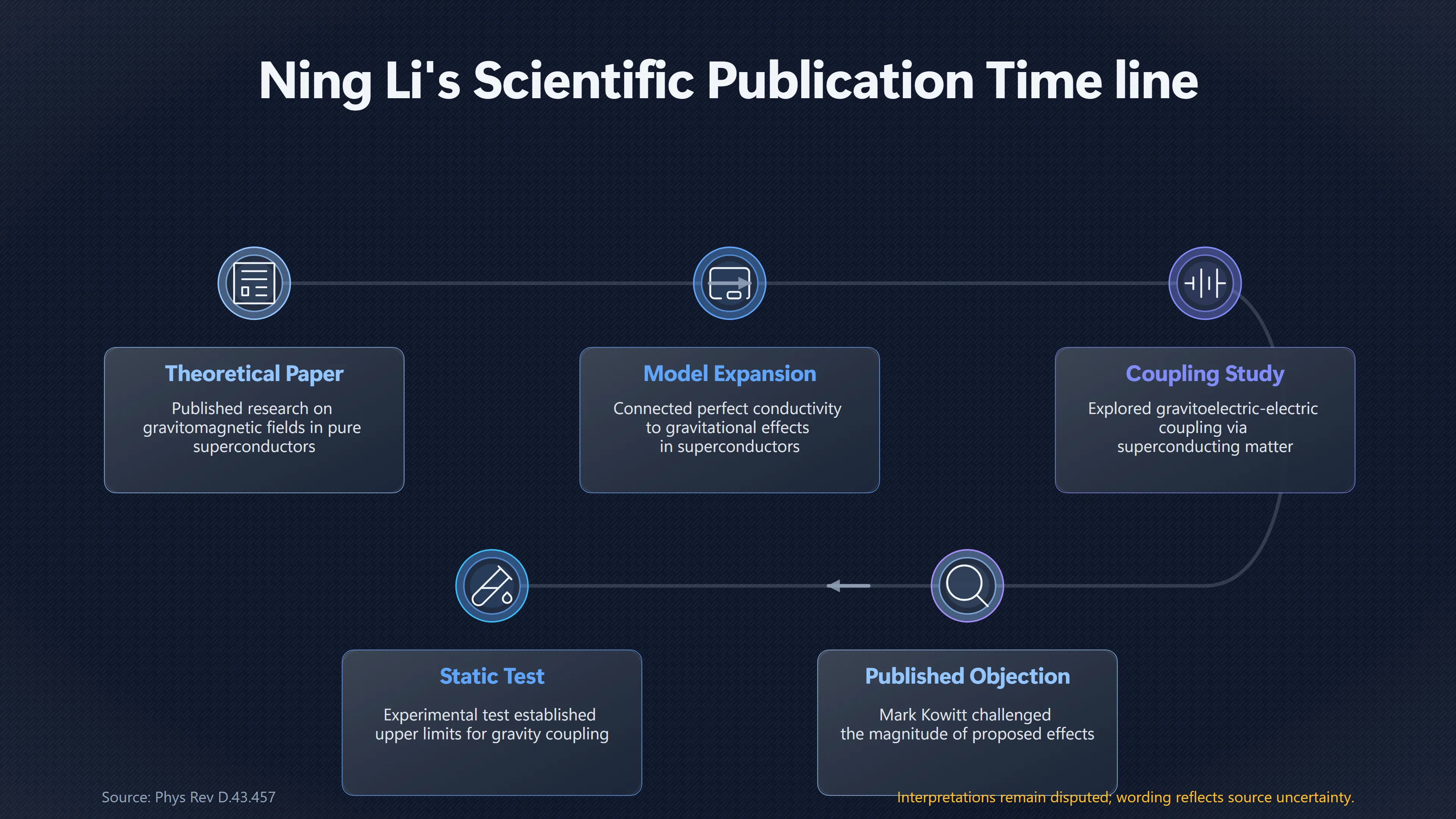
Li’s association with antigravity begins with real work in gravitational physics rather than with later UFO literature. In 1991, Li and Torr published “Effects of a gravitomagnetic field on pure superconductors” in the American Physical Society’s Physical Review D. The subject was gravitomagnetism: a weak gravitational analogue of magnetism that appears when general relativity is expressed in a form resembling electromagnetism. Their paper examined how an external gravitomagnetic field and an ordinary magnetic field might behave inside a pure superconductor.[APS Journals]journals.aps.orgPhys Rev D.43.457APS JournalsEffects of a gravitomagnetic field on pure superconductors | Phys. Rev. DJanuary 15, 1991…
That paper is sometimes described loosely as an antigravity proposal, but its published abstract is considerably less dramatic. Li and Torr calculated that the magnetic and gravitomagnetic fields could induce small internal perturbations in one another and discussed how a combination of the fields would decay inside the superconductor. The paper did not report a levitating object, gravitational shielding or an experimental demonstration of propulsion. It was a theoretical calculation about field behaviour.[OSTI]osti.govEffects of a gravitomagnetic field on pure superconductors (Journal Article) | OSTI.GOVJanuary 15, 1991…
Their 1992 Physical Review B paper, “Gravitational effects on the magnetic attenuation of superconductors”, pushed the proposed relationship further. Li and Torr constructed a theoretical model connecting two familiar properties of an ideal superconductor — perfect conductivity and perfect diamagnetism — when gravitational effects were included. Their stated conclusion was that gravity might have some importance for understanding superconductivity. Again, publication meant that the argument had entered the scientific literature; it did not mean that an anomalously large gravitational effect had been experimentally established.[APS Journals]journals.aps.orgAPS JournalsGravitational effects on the magnetic attenuation of superconductors | Phys. Rev. B…
A further paper by Torr and Li, published in Foundations of Physics Letters in 1993, explored “gravitoelectric-electric coupling via superconductivity”. Taken together, these papers show why it is inaccurate simply to dismiss Li as somebody to whom antigravity ideas were attached after the fact. She and her collaborators really were examining possible links between gravity, electromagnetism and superconducting matter.[OUCI]ouci.dntb.gov.uaOUCIGravitoelectric-electric coupling via superconductivityOUCIGravitoelectric-electric coupling via superconductivity
But the reverse exaggeration is equally misleading. A theoretical paper can establish that a proposed mechanism is mathematically worth discussing without establishing that nature produces the predicted effect at a useful — or even measurable — magnitude.
The theory met a serious published objection
One of the most useful documents for judging the limits of Li’s claims appeared in the same mainstream scientific literature as her own work. In 1994, Mark Kowitt published “Gravitomagnetism and magnetic permeability in superconductors” in Physical Review B, directly addressing Li and Torr’s 1992 calculations.[APS Journals]journals.aps.orgJournals Physical Review BAPS JournalsPhysical Review B - Recent Articles…
Kowitt’s objection concerned the treatment of magnetic permeability in a superconductor. His analysis argued that Li and Torr had interpreted the permeability used to describe the macroscopic Meissner effect in a way that caused the calculated gravitomagnetic effect to be grossly overestimated. In other words, the dispute was not over whether general relativity contains gravitomagnetic phenomena; it concerned whether superconductivity could amplify the relevant coupling to anything resembling the extraordinary magnitude suggested by the model.[ResearchGate]researchgate.netOpen source on researchgate.net.
That distinction is crucial. Gravitomagnetism itself is not synonymous with antigravity. The controversial step was the proposed route from extremely weak gravitational effects to something sufficiently enhanced by superconducting matter to become experimentally important.
Nor was the wider gravity-shielding question insulated from experimental criticism. In 1996, C. S. Unnikrishnan examined reported superconducting gravitational-shielding effects in Physica C. He argued that the existing observations were internally inconsistent with the shielding hypothesis and reported that preliminary static experiments showed no evidence for the claimed effect.[ScienceDirect]sciencedirect.comScienceDirect Does a superconductor shield gravity?ScienceDirect Does a superconductor shield gravity?
The resulting historical picture is therefore not one of an accepted breakthrough abruptly disappearing from science. It is one of a speculative but publishable proposal encountering the normal combination of theoretical criticism and experimental testing.
What Li’s 1997 experiment actually found
The most important evidence for assessing claims that Li “proved antigravity” is her own experimental publication.
In 1997, Li, David Noever, Tony Robertson, Ron Koczor and Whitt Brantley published “Static test for a gravitational force coupled to type II YBCO superconductors” in Physica C. YBCO — yttrium barium copper oxide — is a high-temperature superconducting material. The experiment was connected with NASA’s Marshall Space Flight Center, and NASA’s Technical Reports Server preserves the bibliographic record of the published study.[ScienceDirect]sciencedirect.comStatic test for a gravitational force coupled to type II YBCO superconductors - ScienceDirect…
The experiment was motivated partly by earlier reports of anomalous weight changes around superconductors. Those reports included claimed reductions of roughly 0.05 to 2.1 per cent above a rotating type-II superconductor, as well as a much smaller reported effect above a stationary one. Li and her colleagues did not simply cite those observations as established fact; they subjected the static case to a sensitive test.[ScienceDirect]sciencedirect.comOpen source on sciencedirect.com.
Their apparatus used bulk YBCO superconductors levitated in a direct-current magnetic field, with a sensitive gravimeter measuring whether the local gravitational acceleration changed. The result was stringent: any measured change was less than two parts in 10^8 of normal gravitational acceleration. The authors explicitly stated that this result imposed new limits on the strength and range of a proposed coupling between static superconductors and gravity.[ScienceDirect]sciencedirect.comStatic test for a gravitational force coupled to type II YBCO superconductors - ScienceDirect…
That figure provides a particularly revealing comparison. A change of two parts in 10^8 is 0.000002 per cent. The earlier stationary-superconductor claim discussed in Li’s paper was five parts in 10^4, or 0.05 per cent. Li’s team’s bound was therefore about 25,000 times smaller than that earlier claimed static variation.[ScienceDirect]sciencedirect.comStatic test for a gravitational force coupled to type II YBCO superconductors - ScienceDirect…
This was not a successful demonstration of gravitational shielding. It was a null result with a quantitative upper limit.
There is an important experimental qualification. Li’s 1997 test involved a static, non-rotating superconductor and therefore did not reproduce every condition of the more spectacular rotating-superconductor claims. A null result in the static configuration cannot logically prove that every conceivable rotating or dynamically driven superconducting arrangement produces no unusual gravitational phenomenon. But it does rule out a broad interpretation in which simply placing this kind of superconducting material in the tested configuration causes anything like the previously reported static gravitational anomaly.[ScienceDirect]sciencedirect.comStatic test for a gravitational force coupled to type II YBCO superconductors - ScienceDirect…
That is how null experiments advance science: they shrink the range of effects that remain compatible with observation.
Why the null result changes the antigravity story
Li’s experimental record creates an awkward problem for simplified suppression narratives. If the historical story is told only as “physicist discovers antigravity, obtains government interest, then disappears from public view”, the crucial middle stage vanishes. The public scientific literature instead records a progression from theoretical proposals, through published criticism, to an experiment that set a strong upper bound rather than confirming the anticipated anomaly.[APS Journals]journals.aps.orgAPS JournalsGravitational effects on the magnetic attenuation of superconductors | Phys. Rev. B…
This does not make the research meaningless. A well-designed null experiment can be scientifically valuable precisely because it distinguishes an intriguing possibility from an effect that survives measurement. Li and her colleagues described their result as establishing new limits, not as proving that gravitational research involving superconductors could never yield anything interesting.[ScienceDirect]sciencedirect.comStatic test for a gravitational force coupled to type II YBCO superconductors - ScienceDirect…
It also helps separate three propositions that are often blurred together:
- Li investigated unconventional gravity-superconductor physics. This is firmly documented by her publications in mainstream journals.[APS Journals]journals.aps.orgPhys Rev D.43.457APS JournalsEffects of a gravitomagnetic field on pure superconductors | Phys. Rev. DJanuary 15, 1991…
- Li’s theoretical work predicted potentially detectable effects. That, too, belongs to the historical record, although important aspects of the modelling were challenged by other physicists.[APS Journals]journals.aps.orgJournals Physical Review BAPS JournalsPhysical Review B - Recent Articles…
- Li experimentally demonstrated antigravity. Her accessible peer-reviewed experimental record does not support that conclusion. The 1997 static test instead reported a limit below two parts in 10^8 of normal gravitational acceleration.[ScienceDirect]sciencedirect.comStatic test for a gravitational force coupled to type II YBCO superconductors - ScienceDirect…
Those distinctions become particularly important because Li subsequently pursued further gravity research outside the conventional academic publication trail. Public records and later reporting indicate that her company, AC Gravity, received US defence funding for experimental work, while results from that later programme were not publicly published. Contemporary absence of public results can legitimately leave historical questions unanswered, but it cannot retrospectively convert the earlier null experiment into a positive one.[Huntsville Business Journal]huntsvillebusinessjournal.comOpen source on huntsvillebusinessjournal.com.

Missing results are not positive results
Li’s later work is where the evidential boundary becomes especially important. There is documentary support for the existence of subsequent defence-backed research, but far less publicly accessible evidence about its experimental outcome. That gap has encouraged speculation because it follows an unusually interesting scientific career: peer-reviewed unconventional-gravity papers, NASA-associated testing, private-sector research and defence interest.[NASA Technical Reports Server]ntrs.nasa.govOpen source on nasa.gov.
For assessing the science, however, unpublished or unavailable results have to remain unknown, not be treated as successful experiments by default. A missing report could contain a positive result, a negative result, inconclusive measurements, technical difficulties, or work that moved in a different direction. Without the data, apparatus details, uncertainty analysis and opportunity for independent replication, those possibilities cannot be distinguished.
The published evidence is much easier to evaluate because it leaves a visible trail. Li and Torr proposed unusual gravity-superconductor couplings; another physicist published a technical challenge to the magnitude of their prediction; other researchers questioned gravitational-shielding reports; and Li herself co-authored a sensitive experiment that did not detect the claimed static effect.[aps.org]journals.aps.orgAPS JournalsGravitational effects on the magnetic attenuation of superconductors | Phys. Rev. B…
That sequence does not prove that every later idea Li investigated was wrong. It does establish the limit of what can responsibly be claimed from her public scientific record.
Did Ning Li actually prove antigravity?
No. The strongest historically defensible description is that Ning Li was a legitimate physicist who investigated speculative gravity-superconductor interactions seriously enough to publish theoretical work in recognised physics journals and participate in a sensitive experimental test. Her association with antigravity therefore has a genuine scientific origin rather than being wholly a later invention.[APS Journals]journals.aps.orgPhys Rev D.43.457APS JournalsEffects of a gravitomagnetic field on pure superconductors | Phys. Rev. DJanuary 15, 1991…
But “worked on antigravity” and “proved antigravity” are very different claims. The proposed amplification mechanism faced published technical criticism, independent work challenged superconducting gravity-shielding interpretations, and Li’s own 1997 experiment found no detectable static anomaly down to less than two parts in 10^8 of ordinary gravitational acceleration.[aps.org]journals.aps.orgJournals Physical Review BAPS JournalsPhysical Review B - Recent Articles…
That null result is especially significant in discussions of alleged suppression. It shows that the publicly documented Li story already contained scientific uncertainty and negative evidence before the later period that generated mystery around her research. Whatever may have happened in unpublished work afterwards, the surviving peer-reviewed record does not document a demonstrated antigravity technology waiting to be explained by a suppression theory. It documents something more recognisable in frontier science: an ambitious hypothesis, serious attempts to calculate and test it, criticism from other researchers, and an experiment that substantially constrained the effect it was looking for.
Amazon book picks
Further Reading
Books and field guides related to Did Ning Li Actually Prove Antigravity?. Use these as the next step if you want deeper reading beyond the article.
The Hunt for Zero Point
The atomic bomb was not the only project to occupy government scientists during the 1940's. Antigravity technology, originally spearheade...
The Fabric of the Cosmos
'A magnificent challenge to conventional ideas' Financial Times 'I thoroughly enjoyed this book. It manages to be both challenging and en...
Bad Science
Rating: 5.0/5 from 5 Google Books ratings
Have you ever wondered how one day the media can assert that alcohol is bad for us and the next unashamedly run a story touting the benef...
eBay marketplace picks
Marketplace Samples
Live-tested eBay searches with available results related to this page.
Selected fromantigravity poster oneBay.co.uk.



Endnotes
1.
Source: journals.aps.org
Title: Phys Rev D.43.457
Link:https://journals.aps.org/prd/abstract/10.1103/PhysRevD.43.457
Source snippet
APS JournalsEffects of a gravitomagnetic field on pure superconductors | Phys. Rev. DJanuary 15, 1991...
Published: January 15, 1991
2.
Source: journals.aps.org
Link:https://journals.aps.org/prb/abstract/10.1103/PhysRevB.46.5489
Source snippet
APS JournalsGravitational effects on the magnetic attenuation of superconductors | Phys. Rev. B...
3.
Source: sciencedirect.com
Link:https://www.sciencedirect.com/science/article/pii/S0921453497014627
Source snippet
Static test for a gravitational force coupled to type II YBCO superconductors - ScienceDirect...
4.
Source: journals.aps.org
Title: Journals Physical Review B
Link:https://journals.aps.org/prb/recent?ei=ntuwkjqa&page=8577
Source snippet
APS JournalsPhysical Review B - Recent Articles...
5.
Source: osti.gov
Link:https://www.osti.gov/biblio/5986002
Source snippet
Effects of a gravitomagnetic field on pure superconductors (Journal Article) | OSTI.GOVJanuary 15, 1991...
Published: January 15, 1991
6.
Source: ouci.dntb.gov.ua
Title: OUCIGravitoelectric-electric coupling via superconductivity
Link:https://ouci.dntb.gov.ua/en/works/7nJwBNL7/
7.
Source: researchgate.net
Link:https://www.researchgate.net/profile/Mark-Kowitt
8.
Source: researchgate.net
Link:https://www.researchgate.net/publication/298460654_Gravity-Superconductors_interactions_Theory_and_experiment
9.
Source: sciencedirect.com
Title: ScienceDirect Does a superconductor shield gravity?
Link:https://www.sciencedirect.com/science/article/pii/0921453496003401
10.
Source: ntrs.nasa.gov
Link:https://ntrs.nasa.gov/search.jsp?R=19990039542
11.
Source: sciencedirect.com
Link:https://www.sciencedirect.com/science/article/abs/pii/S0921453497014627
12.
Source: journals.aps.org
Link:https://journals.aps.org/prd/issues/114/1
13.
Source: researchgate.net
Link:https://www.researchgate.net/publication/403975508_Unified_Classical_Resonance_Cosmology_UCRC_20_A_fully_classical_scale-invariant_wave-mechanical_framework_invoking_no_quantum_postulates
14.
Source: researchgate.net
Title: (PDF) New experimental evidence for [Podkletnov]({{ ‘podkletnov/’ | relative_url }}) effect
Link:https://www.researchgate.net/publication/363363090_New_experimental_evidence_for_Podkletnov_effect
15.
Source: researchgate.net
Title: (PDF) Interaction Between Macroscopic Quantum Systems and Gravity
Link:https://www.researchgate.net/publication/361488107_Interaction_Between_Macroscopic_Quantum_Systems_and_Gravity
16.
Source: sciencedirect.com
Link:https://www.sciencedirect.com/science/article/abs/pii/S0921453421001362
17.
Source: researchgate.net
Link:https://www.researchgate.net/publication/354521867_A_simple_investigation_of_Static_test_for_a_gravitational_force_coupled_to_type_II_YBCO_superconductors_by_Li_and_coworkers
18.
Source: researchgate.net
Title: (PDF) Influence of Gravitational Shielding on Time Dilation
Link:https://www.researchgate.net/publication/335099412_Influence_of_Gravitational_Shielding_on_Time_Dilation
19.
Source: researchgate.net
Title: (PDF) New Frontiers in Space Propulsion
Link:https://www.researchgate.net/publication/277278024_New_Frontiers_in_Space_Propulsion
20.
Source: researchgate.net
Link:https://www.researchgate.net/publication/267761628_Theoretical_Study_on_the_Upper_Critical_Field_of_a_Layered_Superconductor_NbSe_2
21.
Source: researchgate.net
Title: (PDF) Gravity-Superconductors Interactions: Historical Background
Link:https://www.researchgate.net/publication/281439915_Gravity-Superconductors_Interactions_Historical_Background
22.
Source: researchgate.net
Title: (PDF) Reverse Engineering Podkletnov’s Experiments
Link:https://www.researchgate.net/publication/251709923_Reverse_Engineering_Podkletnov%27s_Experiments
23.
Source: researchgate.net
Title: Testing the Li-Torr-Chiao conjecture: A novel HFGW detector?
Link:https://www.researchgate.net/publication/234969415_Testing_the_Li-Torr-Chiao_conjecture_A_novel_HFGW_detector
24.
Source: sciencedirect.com
Title: Experiment to detect [frame dragging]({{ ‘frame-dragging/’ | relative_url }}) in a lead superconductor
Link:https://www.sciencedirect.com/science/article/pii/S0921453407013937
25.
Source: researchgate.net
Link:https://www.researchgate.net/publication/1971465_Gravitomagnetic_Fields_in_Rotating_Superconductors_to_Solve_Tate%27s_Cooper_Pair_Mass_Anomaly
26.
Source: sciencedirect.com
Link:https://www.sciencedirect.com/science/article/abs/pii/S0921453405007458
27.
Source: researchgate.net
Title: (PDF) Applications of High-Frequency Gravitational Waves (HFGWs)
Link:https://www.researchgate.net/publication/228343813_Applications_of_High-Frequency_Gravitational_Waves_HFGWs
28.
Source: researchgate.net
Title: (PDF) Gravito-Electromagnetic Properties of Superconductors
Link:https://www.researchgate.net/publication/1944840Gravito-Electromagnetic_Properties_of_Superconductors-A_Brief_Review-
29.
Source: researchgate.net
Link:https://www.researchgate.net/publication/1967822_Weight_Measurements_of_High-Temperature_Superconductors_during_Phase_Transition_in_Stationary_Non-Stationary_Condition_and_under_ELF_Radiation
30.
Source: sciencedirect.com
Title: Gravitomagnetic field of a rotating superconductor and of a rotating superfluid
Link:https://www.sciencedirect.com/science/article/pii/S0921453402023055
31.
Source: sciencedirect.com
Title: Gravitomagnetic field of a rotating superconductor and of a rotating superfluid
Link:https://www.sciencedirect.com/science/article/abs/pii/S0921453402023055
32.
Source: researchgate.net
Title: (PDF) Trip Report and meeting minutes from the 1st International HFGW Workshop
Link:https://www.researchgate.net/publication/316147560_Trip_Report_and_meeting_minutes_from_the_1st_International_HFGW_Workshop
33.
Source: researchgate.net
Title: Gravity modification by high-temperature superconductors
Link:https://www.researchgate.net/publication/269216231_Gravity_modification_by_high-temperature_superconductors
34.
Source: sciencedirect.com
Title: Local gravitoelectromagnetic effects on a superconductor
Link:https://www.sciencedirect.com/science/article/pii/S0921453400003403
35.
Source: researchgate.net
Title: (PDF) NASA breakthrough propulsion physics program
Link:https://www.researchgate.net/publication/222305815_NASA_breakthrough_propulsion_physics_program
36.
Source: ntrs.nasa.gov
Link:https://ntrs.nasa.gov/search.jsp?R=19990104365
37.
Source: researchgate.net
Link:https://www.researchgate.net/publication/24320571_NASATM-97-206241_Breakthrough_Propulsion_Physics_Workshop_Preliminary_Results
38.
Source: sciencedirect.com
Link:https://www.sciencedirect.com/journal/physica-c-superconductivity-and-its-applications/vol/281/issue/2
39.
Source: journals.aps.org
Link:https://journals.aps.org/prb/issues/49/1
40.
Source: journals.aps.org
Link:https://journals.aps.org/prb/issues/46/9
41.
Source: journals.aps.org
Link:https://journals.aps.org/prd/issues/43/2
42.
Source: journals.aps.org
Link:https://journals.aps.org/prb/issues/38/10
43.
Source: sciencedirect.com
Link:https://www.sciencedirect.com/author/7004744470/c-s-unnikrishnan
44.
Source: sciencedirect.com
Title: Reverse Engineering Podkletnov’s Experiments
Link:https://www.sciencedirect.com/science/article/pii/S1875389211005803
45.
Source: researchgate.net
Link:https://www.researchgate.net/publication/386695026_Superconductor_in_a_weak_static_gravitational_field
46.
Source: researchgate.net
Link:https://www.researchgate.net/publication/277311313_Gravitoelectromagnetic_Theories_and_Their_Applications_to_Advanced_Science_and_Technology
47.
Source: researchgate.net
Link:https://www.researchgate.net/profile/Glen-Robertson
48.
Source: researchgate.net
Link:https://www.researchgate.net/profile/Robert-Ecke
49.
Source: researchgate.net
Link:https://www.researchgate.net/publication/228659858_Gravitational_Wave_GW_Radiation_Pattern_at_the_Focus_of_a_High-Frequency_GW_HFGW_Generator_and_Aerospace_Applications
50.
Source: researchgate.net
Link:https://www.researchgate.net/publication/234929198_High-Frequency_Gravitational_Wave_HFGW_Generation_by_Means_of_X-ray_Lasers_and_Detection_by_Coupling_Linearized_GW_to_EM_Fields
51.
Source: researchgate.net
Link:https://www.researchgate.net/publication/402834861Unified_Classical_Resonance_Model_UCRM_Resonant_Plasmoids_Bio-ELFPsionics_Sixth_Oscillator_Remote_ViewingESP_Anomalous_Cognition_Gravity_Control_and_Zero-Point_Energy_Rectification-_The_MC-BE-CIRE_Hy/download
52.
Source: researchgate.net
Link:https://www.researchgate.net/publication/234969235_Review_of_Claims_of_Interaction_Between_Gravitation_and_High-Temperature_Superconductors
53.
Source: researchgate.net
Link:https://www.researchgate.net/publication/269216138_Exploration_of_anomalous_gravity_effects_by_magnetized_high-Tc_superconducting_oxides
54.
Source: everything.explained.today
Link:https://everything.explained.today/Ning_Li_%28physicist%29/
55.
Source: huntsvillebusinessjournal.com
Link:https://huntsvillebusinessjournal.com/news/2023/07/30/solving-the-mystery-of-huntsvilles-brilliant-scientist-disappearing/
56.
Source: mdpi.com
Title: Superconductors and Gravity
Link:https://www.mdpi.com/2073-8994/14/3/554
57.
Source: zamandayolculuk.com
Link:https://www.zamandayolculuk.com/html-3/electrostatic_propulsion.htm
59.
Source: deepdyve.com
Link:https://www.deepdyve.com/lp/american-physical-society-aps/effects-of-a-gravitomagnetic-field-on-pure-superconductors-6alMKHnwD6
60.
Source: uapmurders.com
Link:https://uapmurders.com/uaps/Details/Ning_Li/
61.
Source: a.osmarks.net
Title: Gravitational shielding
Link:https://a.osmarks.net/content/wikipedia_en_all_maxi_2020-08/A/Gravitational_shielding
62.
Source: wikidata.org
Title: Gravitoelectric-electric coupling via superconductivity
Link:https://www.wikidata.org/wiki/Q55922207
63.
Source: daviddarling.info
Link:https://www.daviddarling.info/encyclopedia/A/antigravity.html
64.
Source: independent.academia.edu
Title: Mark Kowitt
Link:https://independent.academia.edu/MarkKowitt
65.
Source: openurl.ebsco.com
Link:https://openurl.ebsco.com/c/t4a2lo/results?bquery=AU+Yuan%2C+Kai&link_origin=&searchDescription=Yuan%2C+Kai&sid=ebsco%3Aocu%3Arecord
66.
Source: openurl.ebsco.com
Link:https://openurl.ebsco.com/results?bquery=AU+Xiao%2C+Lixia&link_origin=&searchDescription=Xiao%2C+Lixia&sid=ebsco%3Aocu%3Arecord&sortBy=date
67.
Source: openurl.ebsco.com
Link:https://openurl.ebsco.com/results?bquery=AU+Che%2C+Tong&page=1&sid=ebsco%3Aocu_results%3Acache
68.
Source: science.gov
Link:https://www.science.gov/topicpages/y/ybco%2Bmelted%2Bsamples
Additional References
69.
Source: pubmed.ncbi.nlm.nih.gov
Title: Pub Med Gravitational effects on the magnetic attenuation of superconductors
Link:https://pubmed.ncbi.nlm.nih.gov/10004334/
Source snippet
Gravitational effects on the magnetic attenuation of superconductors - PubMed...
70.
Source: pubmed.ncbi.nlm.nih.gov
Title: Pub Med Gravitomagnetism and magnetic permeability in superconductors
Link:https://pubmed.ncbi.nlm.nih.gov/10009347
Source snippet
Gravitomagnetism and magnetic permeability in superconductors - PubMed...
71.
Source: pubmed.ncbi.nlm.nih.gov
Title: Pub Med Effects of a gravitomagnetic field on pure superconductors
Link:https://pubmed.ncbi.nlm.nih.gov/10013404/
Source snippet
Effects of a gravitomagnetic field on pure superconductors - PubMed...
72.
Source: youtube.com
Title: The disappearance of America’s leading anti-gravity researcher
Link:https://www.youtube.com/watch?v=Qsbz8_G9WcU
Source snippet
The Truth About Antigravity: Myths, Legends, and Real Science...
73.
Source: congress.gov
Link:https://www.congress.gov/committees/video/house-small-business/hssm00%26lang%3Den
74.
Source: youtube.com
Title: Superconductors & Gravity Control | Gary Stephenson
Link:https://www.youtube.com/watch?v=msrhrssRmCE
Source snippet
Eugene Podkletnov on Gravitational Shielding in Rotating Superconductors...
75.
Source: youtube.com
Title: The Truth About Antigravity: Myths, Legends, and Real Science
Link:https://www.youtube.com/watch?v=-P6san8AGO0
Source snippet
Superconductors & Gravity Control | Gary Stephenson...
76.
Source: shinysideout.com.au
Link:https://www.shinysideout.com.au/13-ning-li.html
77.
Source: anthrowiki.at
Link:https://anthrowiki.at/Antigravitation
78.
Source: deepdyve.com
Link:https://www.deepdyve.com/lp/springer-journals/comments-on-gravitoelectric-electric-coupling-via-superconductivity-by-2QiSKtiNoe