Within Pattern Illusion
Why Coincidences Start Looking Like a Hidden Plot
People who perceive structure in ambiguous or random information may also find hidden connections among otherwise unrelated tragedies more persuasive.
On this page
- What experiments on illusory pattern perception found
- Why ambiguous events invite stronger pattern completion
- How uncertainty differs from evidence of coordination
Page outline Jump by section
Introduction
When several scientists or engineers associated with UFOs, unconventional propulsion, gravity research or classified aerospace work die or disappear under troubling circumstances, the cases can begin to feel like parts of one story. Psychology offers an important caution about that feeling: human beings are capable of perceiving meaningful structure in information that is actually random or unrelated.
Experiments on illusory pattern perception have linked this tendency to conspiracy belief. Participants who saw patterns in random coin tosses or meaningful images in chaotic visual material were also more receptive to conspiratorial explanations. Other experiments found that diminished feelings of control could increase the detection of patterns that were not really present.[PubMed]pubmed.ncbi.nlm.nih.govConnecting the dots: Illusory pattern perception predicts belief in conspiracies and the supernatural - PubMedSeptember 25, 2017…
This does not prove that allegations surrounding any particular scientist’s death are false. Real conspiracies exist, and suspicious cases require investigation on their individual evidence. The narrower lesson is methodological: the experience of seeing a pattern is not evidence that the events generating it share a cause. That distinction becomes especially important when deaths are ambiguous, the category of supposedly connected researchers is flexible, and the proposed plot is assembled retrospectively.
What experiments on illusory pattern perception found
A particularly relevant series of experiments was published by Jan-Willem van Prooijen, Karen Douglas and Clara De Inocencio. Their question was straightforward: is conspiracy belief associated with a more general tendency to perceive order in random information?
In one study, participants examined sequences generated by repeated virtual coin tosses. Although the sequences were random, participants differed in how strongly they thought the results reflected a pattern or had somehow been determined. Greater pattern perception was associated with stronger belief in both established conspiracy theories and fictitious conspiracies created for the experiment.[Kent Academic Repository]kar.kent.ac.ukKent Academic RepositoryConnecting the Dots: Illusory Pattern Perception Predicts Belief in Conspiracies and the Supernatural - Kent Acad…
That finding matters for conspiracy-style death claims because a list of deaths resembles the coin-toss problem in one important respect. A sequence can contain striking local features — several heads close together, for example — without the generating process being non-random. Likewise, several scientists can die young, die unusually or disappear without those events necessarily having one common organiser. A compelling sequence and a demonstrated causal mechanism are different things.
The researchers did not rely only on coin tosses. In another experiment, participants viewed paintings ranging from highly structured works to chaotic images. Perceiving meaningful figures or patterns in the chaotic paintings predicted conspiracy and supernatural beliefs, whereas perceiving patterns in genuinely structured paintings did not show the same relationship. The distinction is revealing: accurately detecting real structure is not the issue; detecting structure where the stimulus itself supplies little or none is.[PubMed]pubmed.ncbi.nlm.nih.govConnecting the dots: Illusory pattern perception predicts belief in conspiracies and the supernatural - PubMedSeptember 25, 2017…
The studies also suggested that the relationship can run in both directions. Encouraging people to search for patterns influenced relevant beliefs indirectly through perceived patterns, while exposure to texts endorsing conspiracy or paranormal explanations could subsequently increase pattern perception. The authors therefore proposed that conspiracy belief and illusory pattern perception may reinforce one another rather than representing a simple one-way personality trait.[PubMed Central (PMC)]pmc.ncbi.nlm.nih.govPubMed Central (PMC)Connecting the dots: Illusory pattern perception predicts belief in conspiracies and the supernatural - PMC…
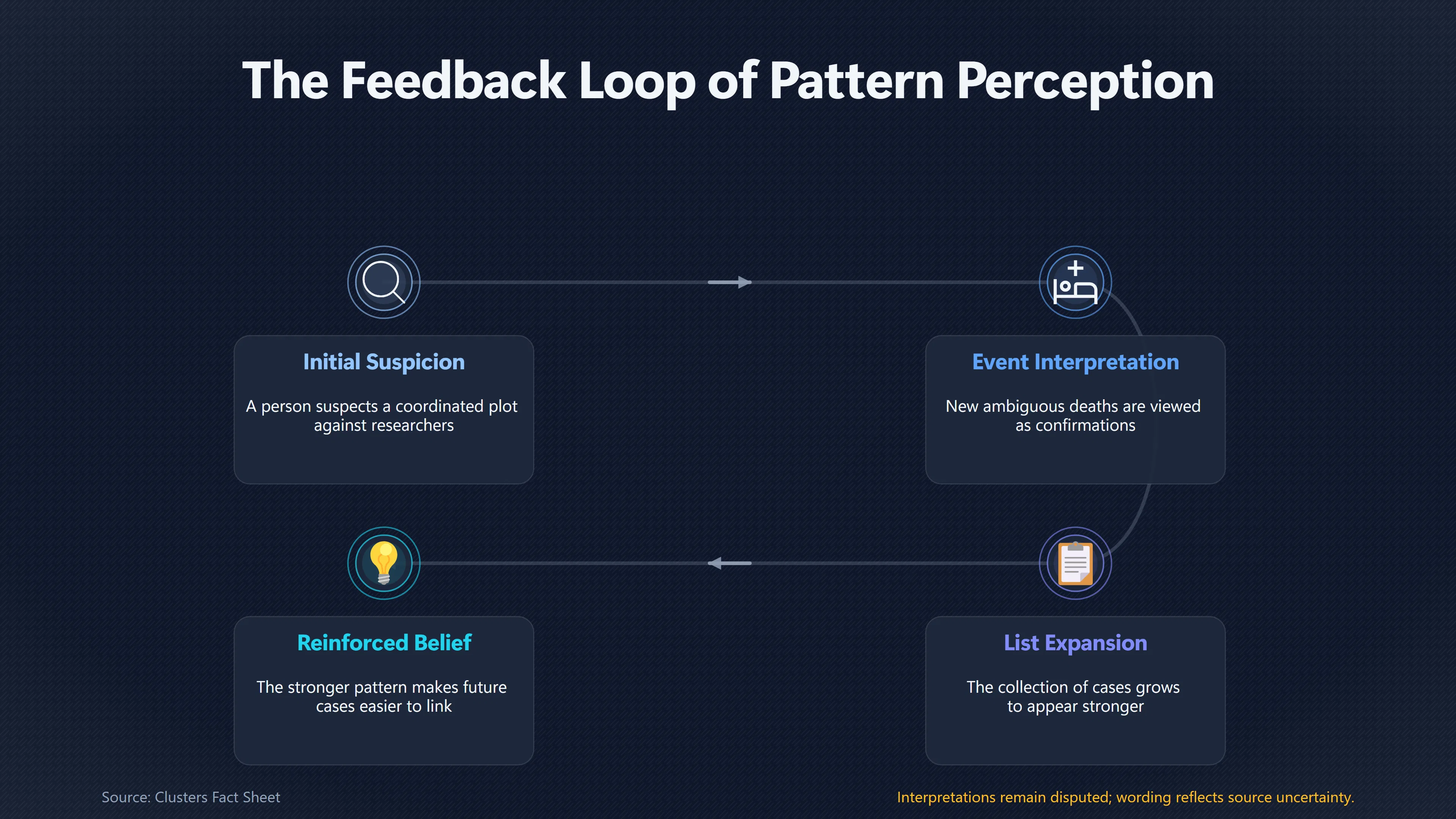
For a narrative about supposedly targeted UFO or antigravity researchers, that creates a plausible feedback loop. Once a person suspects that somebody is eliminating researchers, a later accident, suicide, illness or disappearance is no longer encountered as an isolated event. It arrives as a potential confirmation. Adding it to the list makes the list appear stronger, which in turn makes the next ambiguous case easier to interpret as another part of the pattern.
Why ambiguous deaths invite stronger pattern completion
Ambiguity is particularly fertile ground for this mechanism because it leaves explanatory gaps. An unexplained disappearance has more interpretive space than a death with abundant documentation and an independently established cause. A disputed accident has more room for competing narratives than an event reconstructed from clear physical evidence.
Research on perceived control helps explain why such gaps can become psychologically significant. In six experiments published in Science, Jennifer Whitson and Adam Galinsky manipulated participants’ feelings of control. Participants experiencing reduced control became more likely to perceive images in visual noise, identify illusory relationships in financial information, develop superstitious interpretations and perceive conspiracies. The researchers described these responses as attempts to restore order by identifying coherent relationships among otherwise unrelated stimuli.[PubMed]pubmed.ncbi.nlm.nih.govPub Med Lacking control increases illusory pattern perceptionLacking control increases illusory pattern perception - PubMed…
That result should not be caricatured as saying that people interested in suspicious deaths are irrational. Pattern detection is indispensable to investigation. Detectives connect crimes; epidemiologists identify outbreaks; intelligence analysts search for coordinated behaviour. The difficulty is that the cognitive system responsible for discovering genuine connections can also produce false positives.
A broader review by Douglas, Sutton and Cichocka places this process within the desire to understand important events and reduce uncertainty. Conspiracy explanations can be attractive when information is unavailable, contradictory or difficult to interpret, because they supply intentional causes for events that otherwise appear confusing or arbitrary.[PubMed Central (PMC)]pmc.ncbi.nlm.nih.govPub Med Central (PMC)The Psychology of Conspiracy TheoriesPubMed Central (PMC)The Psychology of Conspiracy Theories - PMCDecember 7, 2017… A much larger 2025 systematic review and meta-analysis, covering 279 independent studies and 137,406 participants, found statistically significant associations between conspiracy belief and epistemic motives concerning knowledge and certainty, as well as existential and social motives. The authors also stressed substantial variation across studies and found weaker associations in experimental than correlational research.[PubMed]pubmed.ncbi.nlm.nih.govReasons to believe: A systematic review and meta-analytic synthesis of the motives associated with conspiracy beliefs - PubMed…
Death claims involving unusual scientific research combine several ingredients that make pattern completion especially tempting: incomplete information, technical subjects outsiders cannot easily evaluate, secrecy that may be genuine even when unrelated to the death, and emotionally consequential outcomes. The absence of an immediately satisfying explanation can therefore become part of the alleged pattern itself.
That creates an important evidential trap. If a death is well explained, it may simply be excluded from the conspiracy list. If it is poorly explained, its uncertainty can be treated as evidence that something was concealed. The cases most capable of sustaining speculation are consequently selected precisely because they contain unresolved questions.
A pattern can grow simply by changing its boundaries
The most important practical problem is not necessarily misperceiving any single event. It is deciding which events belong in the sequence.
Suppose the hypothesis is that scientists working on “antigravity” were targeted. One list might include only researchers explicitly studying gravitational modification. Another might add unconventional propulsion specialists. A third might include aerospace engineers, nuclear physicists, UFO investigators, defence contractors and people working at laboratories associated with classified programmes.
The same flexibility can appear on the outcome side. Does the alleged pattern include murder only? Suicide? Accidents? Cancer? Heart attacks? Missing persons? Researchers who survived apparent attempts on their lives? Once both membership and outcome definitions can expand after cases become known, an impressive-looking cluster becomes much easier to construct.
Research on real-world cluster investigation demonstrates why retrospective selection requires caution. The US National Cancer Institute notes that apparent cancer clusters can arise even when cases have no connection. In a review it cites of 576 investigated apparent clusters, only 72 were confirmed as having elevated cancer rates; three could be linked to a possible exposure, and one produced a clearly identified cause.[Cancer.gov]cancer.govClusters Fact SheetClusters Fact Sheet
Cancer clusters are not equivalent to suspicious-death allegations, but the statistical lesson transfers: observing several conspicuous outcomes is only the beginning of a cluster investigation. One must establish the population at risk, expected frequency, relevant time window and comparison rate before deciding whether the observed concentration is actually unusual.
A striking example comes from Los Alamos, a location particularly relevant to narratives involving sensitive scientific work. Researchers evaluating an apparent brain-cancer cluster there used a space-time scan statistic designed to account for preselection and multiple testing. The observed excess was not statistically significant.[PubMed]pubmed.ncbi.nlm.nih.govOpen source on nih.gov. That result says nothing about unrelated claims concerning individual Los Alamos personnel; it demonstrates the broader point that an alarming-looking concentration can weaken substantially once the analysis accounts for how the cluster was noticed.
This is where illusory pattern perception and retrospective selection interact. Psychology helps explain why the collection feels meaningful; statistics asks whether the collection remains unusual once its construction is controlled for.
Seeing connections is not the same as being unable to detect signals
Later research has added an important qualification to the simple claim that conspiracy believers “see more patterns”. Petra Müller and Matthias Hartmann used signal detection theory, a framework that separates genuine ability to distinguish signal from noise from a person’s threshold for deciding that a signal is present.
In their 2023 study of 723 participants, paranormal beliefs were associated with a more liberal response tendency and lower perceptual sensitivity, with illusory pattern perception playing a clear role. For conspiracy beliefs, however, the result was less straightforward: increased false alarms depended partly on how frequently genuine signals appeared in the task, and the associations were smaller than several other sources of variation.[Nature]nature.comOpen source on nature.com.
That refinement matters. The research does not justify diagnosing anyone who suspects wrongdoing as cognitively defective, nor does it establish that people who endorse conspiracy claims invariably hallucinate connections in random information. The experimental effects are probabilistic, vary by task and can be modest.
Nor does psychological research decide whether a particular conspiracy allegation is true. Van Prooijen and Douglas explicitly note that conspiratorial allegations range from claims highly inconsistent with established evidence to claims that are theoretically plausible; covert wrongdoing does sometimes occur.[PubMed Central (PMC)]pmc.ncbi.nlm.nih.govOpen source on nih.gov. Psychology studies tendencies in how people interpret information. It cannot substitute for forensic evidence, documents, witness testimony or statistical comparison in an individual death investigation.
The more defensible conclusion is narrower: when the evidence is noisy, people can differ in the threshold at which they decide that noise contains a meaningful signal. A narrative about targeted researchers may therefore feel compelling well before it has crossed the evidential threshold needed to establish coordination.
How uncertainty differs from evidence of coordination
This distinction is the key to evaluating conspiracy-style death claims. Uncertainty concerns what has not been established; evidence concerns what has been established. They are not interchangeable.
Consider three hypothetical researchers associated with unconventional propulsion. One dies in an accident with unresolved details; another disappears without a confirmed explanation; a third dies from an apparently ordinary medical cause but had previously worked on classified technology. Those facts legitimately generate questions. They do not, by themselves, demonstrate that the three events had the same cause.
Evidence of coordination would require information that links cases independently of the fact that someone has grouped them together. Useful indicators could include a demonstrable common perpetrator, communications showing shared targeting, a distinctive recurring method unlikely to occur independently, credible documentary evidence of an operation, or an event rate that remains anomalous against a clearly defined comparison population. The crucial feature is that the proposed connection makes testable predictions beyond the original coincidences.
By contrast, several familiar features of a mysterious-deaths narrative can increase its psychological coherence without adding much evidential weight: the victims all had technically interesting jobs; several events remain partly unexplained; the researchers had some connection to government or defence work; the deaths occurred within a memorable span of years; or details from separate cases seem symbolically similar. These observations may justify investigation, but their significance depends on base rates and selection rules.
A useful counterfactual question is: what would the dataset look like if there were no coordinated plot? Researchers in aerospace, physics and defence still experience illness, accidents, suicide, homicide and unexplained disappearances. Some work is classified for ordinary national-security reasons. Some investigations remain unresolved. In a sufficiently large population observed over decades, improbable individual events are inevitable.
The conspiracy hypothesis becomes informative only when it explains something that this ordinary background process does not explain adequately.

The strongest safeguard is to define the pattern before explaining it
Illusory pattern perception is difficult to eliminate because the underlying ability — finding structure — is normally useful. A better safeguard is therefore procedural rather than psychological: make the claimed pattern explicit enough that it could fail.
For alleged deaths connected to UFO or antigravity research, that means fixing the criteria before interpreting the cases. Who exactly qualifies as a relevant researcher? What dates define the observation period? Which outcomes count? How many comparable researchers existed who did not experience those outcomes? What rate would normally be expected among people of similar age, occupation and period? Were the supposedly anomalous cases identified before the theory was proposed, or were they collected afterwards because they fitted it?
These questions transform an evocative narrative into a proposition that can be checked. They also expose an important asymmetry. A conspiracy list usually displays its unusual cases but not its denominator — the much larger number of scientists with similar backgrounds who lived ordinary lives or died in ordinary circumstances. Without that denominator, readers see only the coincidences selected for attention.
This is why the psychology of illusory pattern perception neither proves nor disproves allegations surrounding suspicious scientific deaths. Its contribution is more precise. It explains how a collection of individually ambiguous events can acquire a powerful sense of common design before evidence of common causation has been established. Experiments with random sequences, chaotic images and perceived loss of control show that the human mind can complete patterns when information is noisy; newer research shows that the relationship with conspiracy belief is real but more nuanced than a simple “pattern-seeking personality” account.[PubMed]pubmed.ncbi.nlm.nih.govConnecting the dots: Illusory pattern perception predicts belief in conspiracies and the supernatural - PubMedSeptember 25, 2017…
For claims about UFO, antigravity or unconventional-propulsion researchers, the resulting rule is simple but demanding: unexplained events should remain unexplained until evidence connects them. A mystery in one case cannot serve as the missing link between several others. The hidden plot has to be demonstrated independently of the coincidences that first made it imaginable.
Amazon book picks
Further Reading
Books and field guides related to Why Coincidences Start Looking Like a Hidden Plot. Use these as the next step if you want deeper reading beyond the article.
How We Know What Isn't So: The Fallibility of Human Reason in...
Thomas Gilovich offers a wise and readable guide to the fallacy of the obvious in everyday life. When can we trust what we believe—that "...
Thinking, Fast and Slow
Why is there more chance we'll believe something if it's in a bold type face? Why are judges more likely to deny parole before lunch? Why...
The Drunkard's Walk: How Randomness Rules Our Lives
Leonard Mlodinow reveals the psychological illusions that prevent us understanding everything from stock-picking to wine-tasting, winning...
eBay marketplace picks
Marketplace Samples
Live-tested eBay searches with available results related to this page.
Selected fromUFO poster oneBay.co.uk.

Endnotes
1.
Source: cancer.gov
Title: Clusters Fact Sheet
Link:https://www.cancer.gov/about-cancer/causes-prevention/risk/substances/cancer-clusters-fact-sheet
2.
Source: nature.com
Link:https://www.nature.com/articles/s41598-023-36230-0
3.
Source: cancer.org
Title: Clusters and Patterns of Cancer Cases | American Cancer Society
Link:https://www.cancer.org/cancer/risk-prevention/understanding-cancer-risk/cancer-clusters.html
4.
Source: nature.com
Link:https://www.nature.com/articles/s41598-025-07007-4
5.
Source: nature.com
Link:https://www.nature.com/articles/s41598-024-72812-2
6.
Source: nature.com
Link:https://www.nature.com/articles/s44159-022-00133-0
7.
Source: cancer.gov
Title: Definition of cancer cluster
Link:https://www.cancer.gov/publications/dictionaries/cancer-terms/def/cancer-cluster
8.
Source: nature.com
Link:https://www.nature.com/articles/s41598-024-59434-4
9.
Source: illusory.io
Link:https://www.illusory.io/
10.
Source: ouci.dntb.gov.ua
Link:https://ouci.dntb.gov.ua/en/works/9GJNEYJl/
11.
Source: pubmed.ncbi.nlm.nih.gov
Link:https://pubmed.ncbi.nlm.nih.gov/29695889/
Source snippet
Connecting the dots: Illusory pattern perception predicts belief in conspiracies and the supernatural - PubMedSeptember 25, 2017...
Published: September 25, 2017
12.
Source: pubmed.ncbi.nlm.nih.gov
Title: Pub Med Lacking control increases illusory pattern perception
Link:https://pubmed.ncbi.nlm.nih.gov/18832647/
Source snippet
Lacking control increases illusory pattern perception - PubMed...
13.
Source: kar.kent.ac.uk
Link:https://kar.kent.ac.uk/63244/
Source snippet
Kent Academic RepositoryConnecting the Dots: Illusory Pattern Perception Predicts Belief in Conspiracies and the Supernatural - Kent Acad...
14.
Source: pmc.ncbi.nlm.nih.gov
Link:https://pmc.ncbi.nlm.nih.gov/articles/PMC5900972/
Source snippet
PubMed Central (PMC)Connecting the dots: Illusory pattern perception predicts belief in conspiracies and the supernatural - PMC...
15.
Source: pmc.ncbi.nlm.nih.gov
Title: Pub Med Central (PMC)The Psychology of Conspiracy Theories
Link:https://pmc.ncbi.nlm.nih.gov/articles/PMC5724570/
Source snippet
PubMed Central (PMC)The Psychology of Conspiracy Theories - PMCDecember 7, 2017...
Published: December 7, 2017
16.
Source: pubmed.ncbi.nlm.nih.gov
Link:https://pubmed.ncbi.nlm.nih.gov/39913483/
Source snippet
Reasons to believe: A systematic review and meta-analytic synthesis of the motives associated with conspiracy beliefs - PubMed...
17.
Source: pubmed.ncbi.nlm.nih.gov
Link:https://pubmed.ncbi.nlm.nih.gov/9736881/
18.
Source: pmc.ncbi.nlm.nih.gov
Link:https://pmc.ncbi.nlm.nih.gov/articles/PMC10275861/
19.
Source: pmc.ncbi.nlm.nih.gov
Link:https://pmc.ncbi.nlm.nih.gov/articles/PMC6282974/
20.
Source: cordis.europa.eu
Link:https://cordis.europa.eu/project/id/101018262/results
21.
Source: kar.kent.ac.uk
Link:https://kar.kent.ac.uk/107924/
22.
Source: pmc.ncbi.nlm.nih.gov
Link:https://pmc.ncbi.nlm.nih.gov/articles/PMC11442743/
23.
Source: pmc.ncbi.nlm.nih.gov
Link:https://pmc.ncbi.nlm.nih.gov/articles/PMC11214257/
24.
Source: pmc.ncbi.nlm.nih.gov
Link:https://pmc.ncbi.nlm.nih.gov/articles/PMC11057552/
25.
Source: pmc.ncbi.nlm.nih.gov
Link:https://pmc.ncbi.nlm.nih.gov/articles/PMC10073686/
26.
Source: pmc.ncbi.nlm.nih.gov
Link:https://pmc.ncbi.nlm.nih.gov/articles/PMC9945548/
27.
Source: pmc.ncbi.nlm.nih.gov
Link:https://pmc.ncbi.nlm.nih.gov/articles/PMC9893368/
28.
Source: pmc.ncbi.nlm.nih.gov
Link:https://pmc.ncbi.nlm.nih.gov/articles/PMC9330604/
29.
Source: pubmed.ncbi.nlm.nih.gov
Link:https://pubmed.ncbi.nlm.nih.gov/35785571/
30.
Source: pmc.ncbi.nlm.nih.gov
Link:https://pmc.ncbi.nlm.nih.gov/articles/PMC9142208/
31.
Source: pmc.ncbi.nlm.nih.gov
Link:https://pmc.ncbi.nlm.nih.gov/articles/8989304/
32.
Source: pmc.ncbi.nlm.nih.gov
Link:https://pmc.ncbi.nlm.nih.gov/articles/PMC8957830/
33.
Source: pmc.ncbi.nlm.nih.gov
Link:https://pmc.ncbi.nlm.nih.gov/articles/PMC8354518/
34.
Source: pmc.ncbi.nlm.nih.gov
Link:https://pmc.ncbi.nlm.nih.gov/articles/PMC8355498/
35.
Source: pmc.ncbi.nlm.nih.gov
Link:https://pmc.ncbi.nlm.nih.gov/articles/PMC7857563/
36.
Source: pmc.ncbi.nlm.nih.gov
Link:https://pmc.ncbi.nlm.nih.gov/articles/PMC7488222/
37.
Source: pmc.ncbi.nlm.nih.gov
Link:https://pmc.ncbi.nlm.nih.gov/articles/PMC7375289/
38.
Source: pmc.ncbi.nlm.nih.gov
Link:https://pmc.ncbi.nlm.nih.gov/articles/PMC7324005
39.
Source: pmc.ncbi.nlm.nih.gov
Link:https://pmc.ncbi.nlm.nih.gov/articles/PMC7004178/
40.
Source: pmc.ncbi.nlm.nih.gov
Link:https://pmc.ncbi.nlm.nih.gov/articles/PMC6396711/
41.
Source: pmc.ncbi.nlm.nih.gov
Link:https://pmc.ncbi.nlm.nih.gov/articles/PMC6238178/
42.
Source: pubmed.ncbi.nlm.nih.gov
Link:https://pubmed.ncbi.nlm.nih.gov/30231213/
43.
Source: pubmed.ncbi.nlm.nih.gov
Link:https://pubmed.ncbi.nlm.nih.gov/30555188/
44.
Source: kar.kent.ac.uk
Link:https://kar.kent.ac.uk/68554/
45.
Source: pubmed.ncbi.nlm.nih.gov
Link:https://pubmed.ncbi.nlm.nih.gov/28673250/
46.
Source: pmc.ncbi.nlm.nih.gov
Link:https://pmc.ncbi.nlm.nih.gov/articles/PMC5423964/
47.
Source: pmc.ncbi.nlm.nih.gov
Link:https://pmc.ncbi.nlm.nih.gov/articles/PMC4569808/
48.
Source: pubmed.ncbi.nlm.nih.gov
Link:https://pubmed.ncbi.nlm.nih.gov/25499730/
49.
Source: pubmed.ncbi.nlm.nih.gov
Link:https://pubmed.ncbi.nlm.nih.gov/24477211/
50.
Source: pubmed.ncbi.nlm.nih.gov
Link:https://pubmed.ncbi.nlm.nih.gov/24067663/
51.
Source: pmc.ncbi.nlm.nih.gov
Link:https://pmc.ncbi.nlm.nih.gov/articles/PMC3408895/
52.
Source: pubmed.ncbi.nlm.nih.gov
Link:https://pubmed.ncbi.nlm.nih.gov/20977746/
53.
Source: pmc.ncbi.nlm.nih.gov
Link:https://pmc.ncbi.nlm.nih.gov/articles/PMC2694210/
54.
Source: pmc.ncbi.nlm.nih.gov
Link:https://pmc.ncbi.nlm.nih.gov/articles/PMC1904216/
55.
Source: pmc.ncbi.nlm.nih.gov
Link:https://pmc.ncbi.nlm.nih.gov/articles/PMC1247193/
56.
Source: pubmed.ncbi.nlm.nih.gov
Link:https://pubmed.ncbi.nlm.nih.gov/8870578/
57.
Source: pmc.ncbi.nlm.nih.gov
Link:https://pmc.ncbi.nlm.nih.gov/articles/PMC2359075/?page=0
58.
Source: pubmed.ncbi.nlm.nih.gov
Link:https://pubmed.ncbi.nlm.nih.gov/2162624/
59.
Source: pubmed.ncbi.nlm.nih.gov
Link:https://pubmed.ncbi.nlm.nih.gov/4085443/
60.
Source: pubmed.ncbi.nlm.nih.gov
Link:https://pubmed.ncbi.nlm.nih.gov/8272659/
61.
Source: pmc.ncbi.nlm.nih.gov
Link:https://pmc.ncbi.nlm.nih.gov/articles/PMC1568719/?page=0
62.
Source: ncbi.nlm.nih.gov
Link:https://www.ncbi.nlm.nih.gov/books/NBK233644/
63.
Source: pubmed.ncbi.nlm.nih.gov
Link:https://pubmed.ncbi.nlm.nih.gov/37328598/
64.
Source: pmc.ncbi.nlm.nih.gov
Link:https://pmc.ncbi.nlm.nih.gov/articles/PMC8477633/
65.
Source: pmc.ncbi.nlm.nih.gov
Link:https://pmc.ncbi.nlm.nih.gov/articles/PMC12435987/
66.
Source: pubmed.ncbi.nlm.nih.gov
Link:https://pubmed.ncbi.nlm.nih.gov/40760947/
67.
Source: pmc.ncbi.nlm.nih.gov
Link:https://pmc.ncbi.nlm.nih.gov/articles/PMC7430734/
68.
Source: pmc.ncbi.nlm.nih.gov
Link:https://pmc.ncbi.nlm.nih.gov/articles/PMC12783889/
69.
Source: pmc.ncbi.nlm.nih.gov
Link:https://pmc.ncbi.nlm.nih.gov/articles/PMC8427010/
70.
Source: pubmed.ncbi.nlm.nih.gov
Link:https://pubmed.ncbi.nlm.nih.gov/36741291/
71.
Source: pubmed.ncbi.nlm.nih.gov
Link:https://pubmed.ncbi.nlm.nih.gov/39106578/
72.
Source: pmc.ncbi.nlm.nih.gov
Link:https://pmc.ncbi.nlm.nih.gov/articles/PMC11026417/
73.
Source: pubmed.ncbi.nlm.nih.gov
Link:https://pubmed.ncbi.nlm.nih.gov/30130503/
74.
Source: pmc.ncbi.nlm.nih.gov
Link:https://pmc.ncbi.nlm.nih.gov/articles/PMC6282862/
75.
Source: pmc.ncbi.nlm.nih.gov
Link:https://pmc.ncbi.nlm.nih.gov/articles/PMC4482736/
76.
Source: pmc.ncbi.nlm.nih.gov
Link:https://pmc.ncbi.nlm.nih.gov/articles/PMC8212084/
77.
Source: pmc.ncbi.nlm.nih.gov
Link:https://pmc.ncbi.nlm.nih.gov/articles/PMC10550632/
78.
Source: pmc.ncbi.nlm.nih.gov
Link:https://pmc.ncbi.nlm.nih.gov/articles/PMC10212733/
79.
Source: pubmed.ncbi.nlm.nih.gov
Link:https://pubmed.ncbi.nlm.nih.gov/15371285/
80.
Source: pubmed.ncbi.nlm.nih.gov
Link:https://pubmed.ncbi.nlm.nih.gov/10093240/
81.
Source: pubmed.ncbi.nlm.nih.gov
Link:https://pubmed.ncbi.nlm.nih.gov/8880953/
82.
Source: kar.kent.ac.uk
Title: Main text CLEAN
Link:https://kar.kent.ac.uk/107924/3/Main%20text_CLEAN.pdf
83.
Source: kar.kent.ac.uk
Link:https://kar.kent.ac.uk/48402/
84.
Source: Wikipedia
Link:https://en.wikipedia.org/wiki/Conspiracy
85.
Source: merriam-webster.com
Link:https://www.merriam-webster.com/dictionary/illusory
86.
Source: dictionary.cambridge.org
Link:https://dictionary.cambridge.org/us/dictionary/english/illusory
87.
Source: vocabulary.com
Link:https://www.vocabulary.com/dictionary/illusory
Additional References
88.
Source: research-portal.uu.nl
Link:https://research-portal.uu.nl/en/publications/reasons-to-believe-a-systematic-review-and-meta-analytic-synthesi-2/
89.
Source: research.vu.nl
Link:https://research.vu.nl/en/publications/connecting-the-dots-illusory-pattern-perception-predicts-belief-i/
Source snippet
Vrije Universiteit AmsterdamConnecting the dots: Illusory pattern perception predicts belief in conspiracies and the supernatural - Vrije...
90.
Source: youtube.com
Title: Can You Win an Argument with a Conspiracy Theorist?
Link:https://www.youtube.com/watch?v=fYQCIphJhAk
Source snippet
Suspicious Minds: The Social and Cognitive Psychology of Conspiracy Theories - Rob Brotherton...
91.
Source: in.gov
Link:https://www.in.gov/health/cdpc/cancer/cancer-surveillance-and-data/
92.
Source: cdc.gov
Link:https://www.cdc.gov/mmwr/preview/mmwrhtml/rr6208a1.htm
93.
Source: youtube.com
Title: Suspicious Minds: The Social and Cognitive Psychology of Conspiracy Theories
Link:https://www.youtube.com/watch?v=Y29ARh_ftv4
Source snippet
The Patterned Mind [Explainer]...
94.
Source: researchgate.net
Link:https://www.researchgate.net/publication/319209212_Connecting_the_Dots_Illusory_Pattern_Perception_Predicts_Belief_in_Conspiracies_and_the_Supernatural
95.
Source: researchgate.net
Link:https://www.researchgate.net/publication/398129328Conspiracy_Mentality_Self-Efficacy_Self-Control_Legal_Cynicism_and_Violent_Extremist_Intentions_in_Romanian_Population-_a_Replicate_Study
96.
Source: researchgate.net
Link:https://www.researchgate.net/publication/371638524_Linking_paranormal_and_conspiracy_beliefs_to_illusory_pattern_perception_through_signal_detection_theory
97.
Source: researchgate.net
Link:https://www.researchgate.net/publication/281405422_Someone_is_pulling_the_strings_Hypersensitive_agency_detection_and_belief_in_conspiracy_theories