Within Credentials
Why Strong Credentials Cannot Prove Suppression
Degrees, publications and institutional posts establish research credibility, while claims of covert suppression require separate evidence tied to the alleged
On this page
- What scientific credentials can legitimately establish
- Why credibility does not transfer across different claims
- What independent evidence a suppression allegation requires
Page outline Jump by section
Introduction
Strong scientific credentials can establish that a UFO or unconventional-gravity researcher was a serious scientist. They cannot establish that the researcher was murdered, disappeared, coerced or silenced because of that work. The reason is straightforward:credentials and suppression claims answer different questions.
A doctorate, professorship, peer-reviewed paper or government research contract is evidence about training, professional standing and genuine involvement in research. A suppression allegation is instead a causal claim about what another person or institution secretly did and why. It therefore needs evidence connecting an alleged suppressor to the researcher and to the particular death, disappearance or restriction at issue.
This distinction matters especially in stories about scientists such as James E. McDonald and Ning Li. Their genuine scientific standing makes their histories worth taking seriously. But allowing that credibility to transfer automatically from their research careers to later conspiracy allegations turns biography into evidence for a cause it cannot establish.
What credentials actually establish
Scientific credentials are useful evidence when they are matched to the right question. Ning Li provides an unusually clear example because the documentary record confirms that unconventional gravity research was genuinely part of her professional work, rather than an association invented after she disappeared from public view.
In 1992, Li and Douglas Torr, working at the University of Alabama in Huntsville, published a paper in the American Physical Society’sPhysical Review Bexamining gravitational effects in superconductors. The journal record identifies their institutional affiliation and describes a theoretical model connecting superconductivity with gravitational effects. Li later co-authored an experimental paper examining possible gravitational effects associated with YBCO superconductors. That experiment reported changes in acceleration smaller than two parts in 100 million of ordinary gravitational acceleration under the static conditions tested.
Those records establish something important: Li’s association with gravity-and-superconductor research was real. They also illustrate what peer-reviewed publication doesnotestablish. Publication means that a scientific claim has entered the research literature; it does not mean that the proposed effect has been demonstrated beyond dispute.
Indeed, Li and Torr’s theoretical work was challenged within that same scientific system. Physicist Mark Kowitt published aPhysical Review Bcritique arguing that their treatment substantially overestimated gravitomagnetic effects in superconductors. Later technical literature continued to discuss objections to the Li-Torr calculations. The important point here is not to settle that specialised physics dispute. It is thatscientific credibility operates claim by claim. A qualified physicist can advance an interesting hypothesis, publish it in a reputable journal and still have the hypothesis challenged.
James E. McDonald presents the same distinction in another form. He was a senior atmospheric physicist and professor of meteorology at the University of Arizona who became a prominent advocate for serious scientific investigation of UFO reports. Contemporary and archival accounts identify his substantial academic background and his intensive investigation of UFO cases. His qualifications therefore rebut any suggestion that his UFO involvement can simply be dismissed because he lacked scientific training.
But that is the limit of what those qualifications establish. They do not prove that McDonald’s interpretation of every UFO case was correct, still less that his later death resulted from efforts to suppress his research.
This produces three separate evidential questions that suspicious-death narratives can easily collapse into one:
- Was the person a genuine scientist?Degrees, appointments, professional records and publications can answer this.
- Was the person’s unconventional scientific claim correct?Experiments, replication, criticism and subsequent research must answer that.
- Was the person deliberately suppressed because of that research?Documentary, forensic, witness and causal evidence must answer that.
Evidence that strongly answers the first question may contribute almost nothing to the third.
Why credibility cannot transfer between claims
The underlying problem is an evidential shortcut: a person’s demonstrated reliability in one domain is treated as though it raises the probability of a quite different proposition.
Expert testimony is not worthless. Modern societies necessarily depend on specialised knowledge, and philosophical work on epistemic authority recognises that expertise can provide legitimate reasons for accepting testimony when the authority is reliable in the relevant field. But that authority is domain-sensitive; credentials and institutional positions do not make a person automatically reliable about every proposition connected to their life.
In the UFO-and-antigravity context, the mismatch can become particularly large. Consider the chain:
A scientist had excellent qualifications → the scientist researched an unconventional subject → the scientist later died or ceased publishing → therefore powerful actors probably suppressed the scientist.
The first two propositions can be completely true while the final proposition remains unsupported. The conclusion introduces several new factual claims: that an actor existed with the intention to suppress the research; that the actor knew enough about the scientist to intervene; that it possessed the means to do so; that an intervention actually occurred; and that the later event was caused by that intervention rather than by an independent explanation.
None of those propositions is established by a curriculum vitae.
The distinction is particularly important because genuine credentials can make a narrative psychologically persuasive even where the missing evidence lies elsewhere. Reporting on the use of experts in conspiracy narratives has noted how professional titles can lend unrelated propositions an appearance of authority, especially when readers cannot easily judge the limits of the expert’s relevant expertise. In this branch of UFO history, however, the problem can be subtler still: the scientist need not have endorsed the later conspiracy theory at all. Other people may construct it retrospectively from the scientist’s qualifications, subject matter and fate.
That means even impeccable credentials cannot repair a missing causal link.
Ning Li shows how the gap can create a mystery
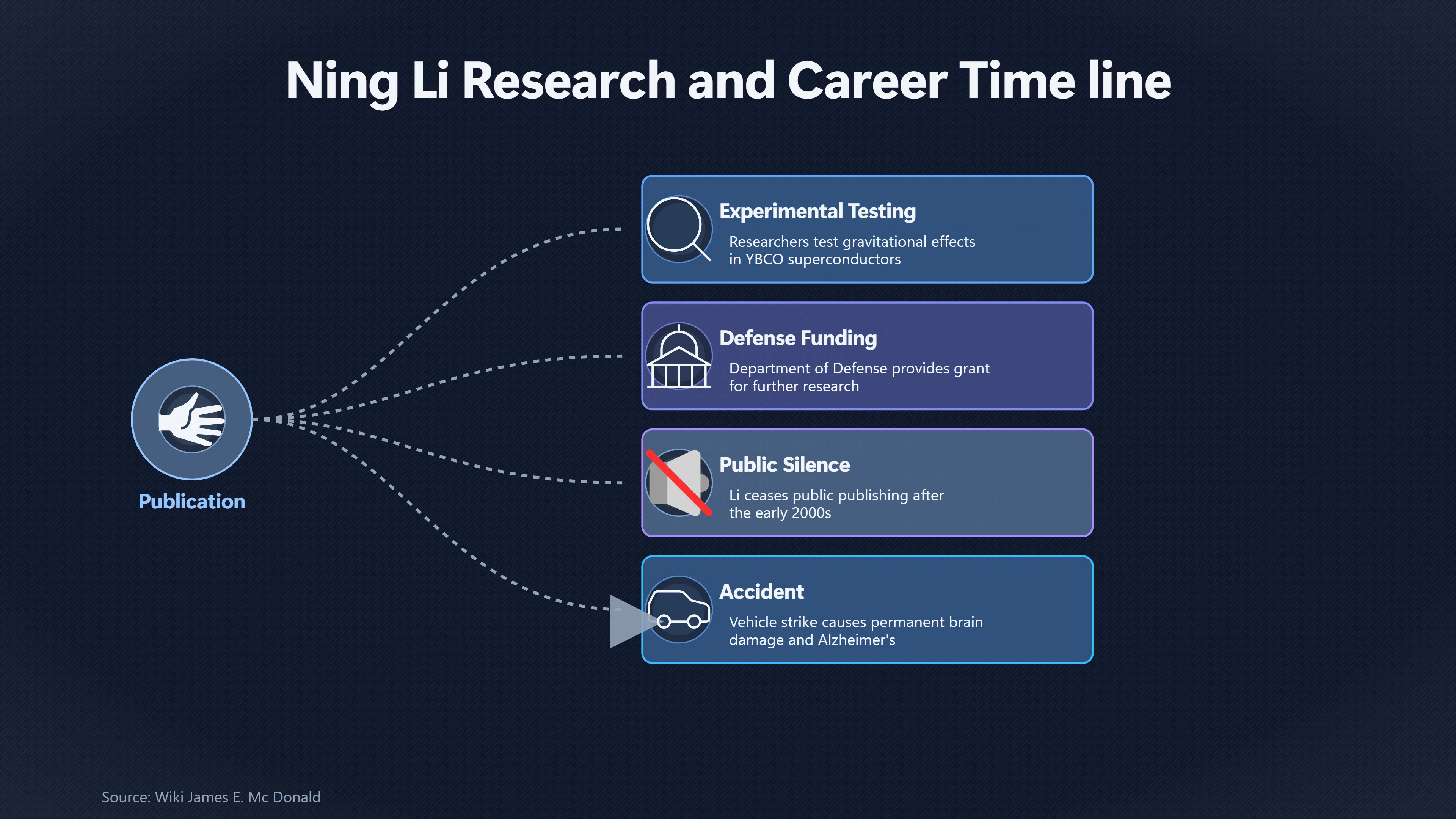
The Ning Li story demonstrates the mechanism unusually well because several ingredients that can make a suppression narrative compelling were genuinely present. She conducted unconventional gravity-related research; she had mainstream scientific publications; she founded AC Gravity; the US Department of Defense funded further work; the results were not publicly released; and her public scientific profile subsequently became extremely quiet. A later investigation reported that AC Gravity received a $448,970 Department of Defense grant and that Li ceased publishing publicly after the early 2000s.
Taken together, those facts reasonably generate questions. They do not determine the answers.
For years, the absence of easily accessible information about Li helped support claims that she had “disappeared”, perhaps after making a breakthrough. Yet the Huntsville Business Journal eventually located and interviewed her son, George Men. He said that Li had remained in the United States and continued defence-related work rather than secretly returning to China. According to his account, her classified employment restricted what she could discuss publicly. In 2014 she was struck by a vehicle near the University of Alabama in Huntsville campus, suffered permanent brain damage, subsequently developed Alzheimer’s disease and never returned to work. She died in 2021.
Some uncertainty remains around what her classified research actually achieved. The journalist reported that Freedom of Information Act requests concerning results of the 2001 grant had been denied. But that uncertainty cannot simply be converted into evidence of a more serious allegation.
This is where the credentials gap becomes visible. Li’s scientific record helps establish thatthere really was unusual research worth asking about. Her defence connection helps establish thatsome later work was not publicly accessible. Neither fact establishes that her accident was engineered, that she was forcibly disappeared, or that a successful antigravity technology was secretly confiscated.
Those propositions require their own evidence.
The case also illustrates why absence of public information must be handled carefully. Before her family’s account became public, “nobody can find out what happened to this accomplished scientist” sounded inherently mysterious. Afterwards, much of that apparent disappearance had an ordinary biographical explanation. The earlier information gap was real; the inference drawn from it was not therefore necessarily correct.
A suspicious chronology is not yet a causal chain
Credentials often combine with chronology to produce an even stronger impression:
important scientist → sensitive discovery → government interest → silence, death or disappearance.
Chronology matters in an investigation. If an alleged threat occurs immediately before a suspicious death, for example, investigators would reasonably examine it. But sequence alone does not establish causation.
A suppression hypothesis must distinguish between events that are merely adjacent in a biography and events that are demonstrably connected. That requires asking whether there is evidence at the point where the narrative changes from documented history to inferred motive.
Suppose records establish that a researcher held a physics doctorate, published an unconventional propulsion paper and later received defence funding. Those records can authenticate the research history. If the next available fact is that the researcher died ten years later, the interval between those facts is not filled by the earlier credentials. To argue homicide or coercion, evidence must bridge it.
McDonald’s history shows why this separation matters from another direction. His credentials and UFO work are well documented, but accounts of his death also report a previous suicide attempt before his fatal death in June 1971; archival UFO material itself describes his death as suicide. That evidence is directly relevant to the manner of death in a way that his academic qualifications are not.
One can therefore simultaneously hold two positions without contradiction: McDonald was a highly qualified scientist whose UFO arguments deserve to be represented accurately, and his qualifications are not evidence that covert actors caused his death.
The same principle prevents an equally poor argument in the opposite direction. A researcher’s unusual beliefs, disputed theory or association with UFOs do not prove that an officially reported suicide, accident or natural death must be correct either. The appropriate standard is symmetrical:neither prestige nor eccentricity substitutes for evidence about what happened.
What a real suppression case would need
Rejecting credentials as proof of conspiracy does not mean suppression is impossible. Governments, corporations and other organisations can classify research, impose secrecy requirements, pressure employees or conceal wrongdoing. A genuine allegation should therefore be investigated using evidence capable of distinguishing deliberate suppression from ordinary scientific disagreement, legitimate classification, personal withdrawal, accident or unrelated death.
For the suspicious-death and disappearance narratives in this field, useful evidence would have to move beyond biography and establish a causal connection. Depending on the allegation, that might include:
- contemporaneous threats specifically connected to the research;
- correspondence or internal records ordering that the researcher be silenced, removed or monitored;
- independently authenticated evidence of coercion or intimidation;
- police, medical or forensic findings inconsistent with the stated circumstances of a death;
- credible witnesses with direct knowledge of an intervention;
- records linking identified actors to both a suppression motive and operational action;
- demonstrable alteration, seizure or destruction of research connected to the alleged suppressors;
- multiple independent sources whose accounts converge on the same specific events.
No single category is automatically decisive. A threatening letter could be genuine but unrelated to a later death; classified files could concern routine defence research rather than a revolutionary discovery; missing laboratory notes could have mundane explanations. The strength of a suppression case comes fromindependent evidence converging on the alleged causal chain, not from the prominence of the scientist at its centre.
This distinction also avoids treating ordinary scientific criticism as suppression. Li’s work, for example, could simultaneously be genuine unconventional physics research and subject to serious technical objections. Her 1992 paper appeared inPhysical Review B, while subsequent physicists criticised elements of the proposed gravitomagnetic mechanism. That is evidence of scientific dispute, not by itself evidence of a campaign to silence her.
Similarly, classification deserves precise language. If a researcher is legally prevented from publicly discussing classified work, that is a real restriction on disclosure. It may legitimately be called secrecy or information control. But the existence of classification does not prove murder, abduction or suppression of a successful breakthrough. Those are additional claims requiring additional evidence.
The most useful rule is claim-by-claim credibility
The strongest way to assess allegedly suppressed UFO or antigravity scientists is neither to dismiss their qualifications nor to turn those qualifications into proof of conspiracy. It is to keep each proposition attached to the evidence capable of supporting it.
For Ning Li, mainstream journal records establish genuine gravity-and-superconductor research. Later reporting and family testimony establish important facts about her subsequent life that were missing from earlier “disappearance” narratives. What remains classified remains uncertain.
For James McDonald, academic and archival records establish a substantial scientific career and serious engagement with UFO investigation. Evidence concerning the circumstances of his death belongs to a different evidential category and must be assessed independently.
That separation is not a device for dismissing controversial researchers. It actually protects their historical credibility. It allows a researcher to be recognised as accomplished without requiring every theory attributed to them to be correct, and allows their unconventional work to be examined without making later tragedy proof of a hidden plot.
The decisive question in a suppression allegation is therefore not“How impressive was this scientist?”It is“What independent evidence connects the alleged suppressor to what happened?”Until that bridge is supplied, strong credentials can authenticate the scientist and the research story, but they cannot prove the conspiracy.
Amazon book picks
Further Reading
Books and field guides related to Why Strong Credentials Cannot Prove Suppression. Use these as the next step if you want deeper reading beyond the article.
The Demon-Haunted World: Science as a Candle in the Dark
Rating: 4.5/5 from 43 Google Books ratings
NEW YORK TIMES BESTSELLER • From the renowned astronomer and author of Cosmos comes a “powerful [and] stirring defense of informed ration...
Bad Science
Rating: 5.0/5 from 5 Google Books ratings
Have you ever wondered how one day the media can assert that alcohol is bad for us and the next unashamedly run a story touting the benef...
Calling Bullshit: The Art of Skepticism in a Data-Driven World
It's not just fake news. Bullshit is everywhere. Now, two science professors give us the tools to dismantle misinformation and think clea...
The Skeptics' Guide to the Universe: How to Know What's Reall...
An all-encompassing guide to skeptical thinking from podcast host and academic neurologist at Yale University School of Medicine Steven N...
eBay marketplace picks
Marketplace Samples
Live-tested eBay searches with available results related to this page.
Selected fromUFO poster oneBay.co.uk.

Endnotes
1.
Source: ufos.wiki
Title: Wiki James E. Mc Donald
Link:https://ufos.wiki/figure/james-e-mcdonald/
2.
Source: june.kim
Link:https://june.kim/science-on-trial
3.
Source: wikidata.org
Title: Ning Li
Link:https://www.wikidata.org/wiki/Q11170087
4.
Source: zamandayolculuk.com
Link:https://zamandayolculuk.com/html-3/electrostatic_propulsion.htm
5.
Source: sciencedirect.com
Link:https://www.sciencedirect.com/journal/physica-c-superconductivity-and-its-applications/vol/281/issue/2
6.
Source: researchgate.net
Link:https://www.researchgate.net/profile/Mark-Kowitt
7.
Source: daviddarling.info
Link:https://www.daviddarling.info/encyclopedia/U/UFOs.html
8.
Source: nomad-laboratory.de
Link:https://nomad-laboratory.de/scheffler?pub=1
9.
Source: uapmurders.com
Link:https://uapmurders.com/uaps/Details/Ning_Li/
10.
Source: philosophy.lander.edu
Link:https://philosophy.lander.edu/logic/authority.html
11.
Source: hangar1publishing.com
Title: antigravity technology
Link:https://hangar1publishing.com/blogs/ufos-uaps-and-aliens/antigravity-technology
12.
Source: independent.academia.edu
Title: Mark Kowitt
Link:https://independent.academia.edu/MarkKowitt
Additional References
13.
Source: cambridge.org
Link:https://www.cambridge.org/core/journals/journal-of-the-american-philosophical-association/article/conspiracy-theories-populism-and-epistemic-autonomy/52D3A6C4B3201DE23C3B833C167439B4
Source snippet
Cambridge University PressConspiracy Theories, Populism, and Epistemic Autonomy | Journal of the American Philosophical Association | Cam...
14.
Source: sciencedirect.com
Link:https://www.sciencedirect.com/science/article/abs/pii/S0921453497014627
Source snippet
Static test for a gravitational force coupled to type II YBCO superconductors - ScienceDirectAugust 1, 1997...
Published: August 1, 1997
15.
Source: dokumen.pub
Link:https://dokumen.pub/gravity-superconductors-interactions-theory-and-experiment-1nbsped-9781608053995-9781608054008.html
Source snippet
Gravity-Superconductors Interactions: Theory and Experiment [1 ed.] 9781608053995, 9781608054008 - DOKUMEN.PUB...
16.
Source: sciencedirect.com
Link:https://www.sciencedirect.com/science/article/pii/S0921453497014627
Source snippet
Static test for a gravitational force coupled to type II YBCO superconductors - ScienceDirect...
17.
Source: journals.aps.org
Link:https://journals.aps.org/prb/abstract/10.1103/PhysRevB.46.5489
Source snippet
APS JournalsGravitational effects on the magnetic attenuation of superconductors | Phys. Rev. B...
18.
Source: youtube.com
Title: What’s the truth about antigravity?
Link:https://www.youtube.com/watch?v=_SGnOeGZUAU
Source snippet
Barely Sociable The Scientist That Discovered Antigravity Then Disappeared Completely The Scientist That "Discovered Antigravity" Then Di...
19.
Source: youtube.com
Title: The disappearance of America’s leading anti-gravity researcher
Link:https://www.youtube.com/watch?v=Qsbz8_G9WcU
Source snippet
The Scientist That "Discovered Antigravity" Then Disappeared Completely - An Unsolved Mystery...
20.
Source: ufor.asn.au
Title: UFORDr James E Mc Donald’s Archives
Link:https://www.ufor.asn.au/archives/articles/james-e-mcdonald-ufo-researcher-archives/
Source snippet
Dr James E McDonald’s Archives - UFO Research (NSW) Incorporated, Sydney, AustraliaApril 15, 2016...
Published: April 15, 2016
21.
Source: ufos-scientificresearch.blogspot.com
Title: Unidentified Anomalous Phenomena
Link:https://ufos-scientificresearch.blogspot.com/2019/02/anomalous-aerospace-phenomena-and-anti.html
Source snippet
scientific research: Anomalous Aerospace Phenomena; and "anti-gravity"...
22.
Source: youtube.com
Title: The Scientist That “Discovered Antigravity” Then Disappeared Completely
Link:https://www.youtube.com/watch?v=eS_rEzKdzBA
Source snippet
The Ning Li Disappearance | Noah Logan...