Within Accidents
Why Unusual Research Makes Accidents Look Suspicious
Work on antigravity or other extraordinary subjects can make an otherwise ordinary accident seem meaningful even without evidence of a connection.
On this page
- How controversial research supplies an apparent motive
- The gap between speculative science and proven technology
- Why occupational intrigue can distort causal judgment
Page outline Jump by section
Introduction
Researchers who work on UFOs, gravity control or other extraordinary subjects can make an otherwise ordinary accident look unusually significant. The mechanism is straightforward: the research supplies a ready-made motive. Once a scientist is imagined to possess knowledge capable of transforming aviation, energy or defence, a later collision, disappearance from public life or sudden death can be interpreted through that story even when the accident evidence itself does not point to deliberate interference.
Two cases illustrate the problem particularly well. Physicist Ning Li’s work on superconductors and gravity, followed by defence-funded research and years of public silence, made her later road accident unusually susceptible to suspicion. Harvard psychiatrist John Mack’s controversial investigation of alleged alien-abduction experiences similarly gave his fatal 2004 pedestrian collision a UFO-related context it would not otherwise have possessed. Yet the available evidence concerning both accidents is mundane rather than conspiratorial.[aps.org]journals.aps.orgAPS JournalsGravitational effects on the magnetic attenuation of superconductors | Phys. Rev. BSeptember 1, 1992…
The important distinction is between a plausible motive imagined from the research and evidence that the motive actually caused the accident. Extraordinary research can make the first remarkably easy to construct without providing the second.
How controversial research supplies an apparent motive
An ordinary accident normally invites ordinary questions: Was a driver impaired? Was visibility poor? Was somebody distracted? When the victim is associated with supposed antigravity technology or UFO secrets, however, another question arrives almost automatically: Who might have wanted this person stopped?
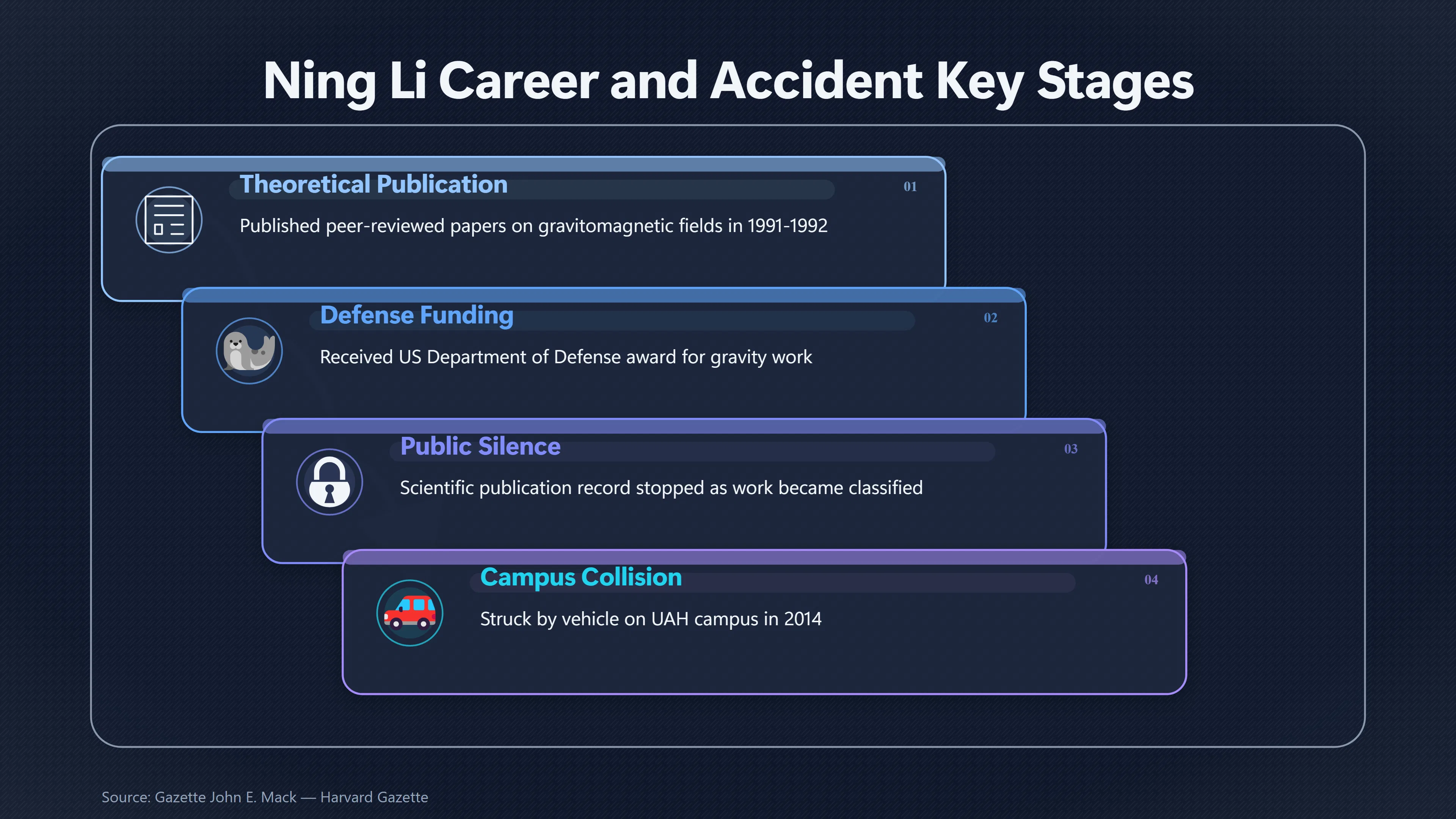
Ning Li’s career shows how powerful that reframing can become. Li and Douglas Torr genuinely published gravity-related theoretical work in major physics journals. Their 1991 Physical Review D paper examined gravitomagnetic fields in superconductors, while a 1992 Physical Review B paper considered gravitational effects in superconductivity. These publications are important because they establish a factual core beneath the later mythology: Li really was a professional physicist investigating an unconventional connection between superconductivity and gravity.[APS Journals]journals.aps.orgAPS JournalsEffects of a gravitomagnetic field on pure superconductors | Phys. Rev. D…
Her subsequent career added ingredients that made the story more suggestive. Li left the University of Alabama in Huntsville, formed AC Gravity and received a US Department of Defense award reported at $448,970. Her public publication record then stopped. Huntsville Business Journal’s later investigation found indications that she remained involved in defence work, including a 2003 presentation, while a correspondent was told in 2004 that she was still doing Department of Defense work but could not discuss it.[Huntsville Business Journal]huntsvillebusinessjournal.comHuntsville Business JournalUncovering The Mystery Of Huntsville’s Brilliant Anti-gravity Scientist - Huntsville Business Journal…
Those facts can be assembled into an intuitively compelling sequence:
unusual physics → defence interest → secrecy → disappearance from public science → serious accident.
The sequence feels causal because every element appears to reinforce the next. But rearranging true facts into a compelling story does not establish the causal connection between them. Li’s son told the Huntsville Business Journal that she had remained in the United States rather than defecting to China, as an influential rumour had claimed. He also said that in 2014 she was struck by a vehicle while crossing a street on the UAH campus, suffering permanent brain damage and never returning to work. Her husband witnessed the collision.[Huntsville Business Journal]huntsvillebusinessjournal.comHuntsville Business JournalUncovering The Mystery Of Huntsville’s Brilliant Anti-gravity Scientist - Huntsville Business Journal…
The available public account therefore contains something important that suppression narratives often lack: a mundane event capable of explaining the abrupt end of the researcher’s career. What it does not publicly provide is evidence that the vehicle collision was arranged because of Li’s research.
The distinction matters because secrecy can make an imagined motive seem stronger without making the accident evidence stronger. If a scientist’s last project cannot readily be examined, observers are free to imagine that it succeeded spectacularly. The unknown result becomes, paradoxically, easier to treat as dangerous than a published result whose limitations can actually be assessed.
The gap between speculative science and proven technology
The strongest version of the suppression argument usually depends upon an unstated premise: the researcher was not merely studying something extraordinary but was close to making it work.
That is a much larger claim.
Li’s peer-reviewed papers demonstrate legitimate theoretical research; they do not by themselves demonstrate a working antigravity propulsion system. Her 1992 paper, for example, said its theoretical model suggested that gravitational effects might be important in understanding superconductivity. That is very different from independently demonstrating controllable gravity or an operational propulsion technology.[APS Journals]journals.aps.orgAPS JournalsGravitational effects on the magnetic attenuation of superconductors | Phys. Rev. BSeptember 1, 1992…
The broader history of breakthrough-propulsion research makes the distinction particularly important. NASA’s Breakthrough Propulsion Physics programme deliberately examined ideas such as propellantless drives and other concepts beyond conventional propulsion. Its assessment did not treat unconventional investigation as illegitimate, but it also reported that no propulsion breakthroughs appeared imminent.[NASA Technical Reports Server]ntrs.nasa.govTechnical Reports Server Assessing Potential Propulsion BreakthroughsNASA Technical Reports ServerAssessing Potential Propulsion Breakthroughs - NASA Technical Reports Server (NTRS)December 1, 2005…
NASA encountered enough proposed mechanical antigravity devices that it produced guidance on evaluating them. That guidance noted that apparent thrust can arise from mundane experimental effects such as differential friction or the misinterpretation of torque, and recommended minimum evidential thresholds before supposed breakthroughs were taken further.[NASA Technical Reports Server]ntrs.nasa.govTechnical Reports Server Responding to Mechanical AntigravityNASA Technical Reports ServerResponding to Mechanical Antigravity - NASA Technical Reports Server (NTRS)December 1, 2006…
Superconducting gravity claims faced the same basic difficulty. NASA’s technical assessment discussed attempts related to Eugene Podkletnov’s claimed gravitational shielding effect. One lower-cost superconducting experiment was rendered inconclusive by radio-frequency interference, while the assessment also referred to externally sponsored full replication work. The wider literature cited in NASA’s review contains a recurring pattern of spectacular gravity-related claims followed by null results, experimental complications or lack of decisive independent confirmation.[NASA Technical Reports Server]ntrs.nasa.govNASA Technical Reports ServerE-14560 CoverMay 10, 2004…
This changes how accident-related claims should be evaluated. If there is no public evidence that a researcher possessed a successful revolutionary technology, then the claim that powerful actors needed to eliminate that researcher requires two separate evidential leaps: first that the technology secretly worked, and second that the accident was deliberately caused to suppress it.
Secrecy cannot automatically fill both gaps. A classified project might contain genuinely important findings, disappointing results, incremental technical work or simply information restricted for reasons unrelated to a revolutionary breakthrough. The absence of public results does not tell outsiders which possibility is correct.
John Mack shows how the subject can change the meaning of an accident
John E. Mack provides an especially useful comparison because his controversial research was not antigravity engineering. Mack was a Pulitzer Prize-winning Harvard psychiatrist who became prominent for investigating people reporting alien-abduction experiences. Harvard’s own memorial described this as one of the controversial directions his career took.[Harvard Gazette]news.harvard.eduGazette John E. Mack — Harvard GazetteHarvard GazetteJohn E. Mack — Harvard Gazette…
That association with UFOs gave his death an interpretative frame that an otherwise similar pedestrian fatality might never acquire.
On 27 September 2004, Mack was struck and killed by a car in London. Harvard Medical School’s memorial account states that the vehicle was being driven by a man under the influence of alcohol. Mack was nearly 75 and was still professionally active when he died.[Harvard Gazette]news.harvard.eduGazette John E. Mack — Harvard GazetteHarvard GazetteJohn E. Mack — Harvard Gazette…
The contrast is instructive. Strip away Mack’s UFO work and the event reads as a tragic road death involving an impaired driver. Restore the alien-abduction research and the identical facts can suddenly appear to some readers as the suspicious elimination of a prominent researcher.
That transformation can be seen in the continuing folklore surrounding Mack. UFO discussions years later still circulate allegations that his death was suspicious and sometimes add claims about other people named John Mack supposedly dying in similar circumstances on the same day. Such claims illustrate how an established extraordinary narrative can attract additional coincidences and rumours even though the underlying institutional account describes a traffic collision involving an intoxicated driver.[Reddit]reddit.comToday 20 years ago John Mack was killed in a car accident in londonHe served as the head of the department of psychiatry at Harvard Medical School for over 27 years and was initiating serious studies abou…
This does not mean that an accident involving a controversial researcher could never be deliberate. It means that the controversial research is not itself evidence that this particular accident was deliberate. The causal evidence must come from the incident: forensic anomalies, communications indicating a threat, manipulation of the vehicle, credible witnesses, financial or operational links to a perpetrator, demonstrable deception in the investigation, or comparable evidence.
Without such material, the research topic explains why people suspect suppression better than it demonstrates that suppression occurred.
Why occupational intrigue can distort causal judgement
Psychological research helps explain why these narratives are so compelling without requiring believers to be irrational or dishonest. Human beings naturally look for meaningful relationships between events, especially when events are consequential, surprising or incompletely explained.
Research by Jan-Willem van Prooijen and colleagues found an association between conspiracy belief and illusory pattern perception: the tendency to perceive meaningful connections in stimuli or events that can arise randomly. Their experiments found that conspiracy and supernatural beliefs were associated with detecting patterns in chaotic or random material. Later research has continued to investigate this relationship.[PubMed Central (PMC)]pmc.ncbi.nlm.nih.govOpen source on nih.gov.
A major review by Karen Douglas, Robbie Sutton and Aleksandra Cichocka likewise groups motivations for conspiracy belief into epistemic needs — making sense of events — existential needs involving security and control, and social needs. An unexplained interruption in an extraordinary research programme is almost ideally structured to activate the first two: there is an information gap, the potential stakes seem enormous, and intentional suppression offers a coherent explanation.[Sage Journals]journals.sagepub.comOpen source on sagepub.com.
Probability judgement creates another trap. Research on the conjunction fallacy shows that people can judge a detailed combination of events as more probable because the combined story seems more representative or causally coherent. A statement such as “a scientist was hit by a vehicle” contains little narrative structure. “An antigravity scientist doing secret defence work was hit by a vehicle because somebody wanted her research stopped” is much richer and more intuitively satisfying — but adding a proposed cause does not make the combined event statistically more probable.[Cambridge University Press]cambridge.orgUniversity Press Conjunction fallacy (Chapter 6University Press Conjunction fallacy (Chapter 6
The extraordinary occupation also changes which details seem relevant. In Li’s case, defence funding, unpublished results and gravity research immediately stand out. In Mack’s case, Harvard controversy and alien-abduction research stand out. Yet those details may have no causal relationship whatsoever to the traffic event. A good investigation therefore has to resist allowing biographical intrigue to substitute for evidence from the accident itself.
Secrecy creates ambiguity, not proof
This problem becomes harder when genuine secrecy exists. Ning Li’s case is not simply one in which internet storytellers invented a classified connection from nothing. According to the Huntsville investigation, her son said that she obtained a top-secret clearance and became unable to discuss her work; the journalist also reported unsuccessful Freedom of Information Act efforts to obtain the results of her defence-funded research.[Huntsville Business Journal]huntsvillebusinessjournal.comHuntsville Business JournalUncovering The Mystery Of Huntsville’s Brilliant Anti-gravity Scientist - Huntsville Business Journal…
That creates a legitimate historical gap. It is reasonable to ask what work she performed and why it remained unavailable. But there are two very different propositions:
Proposition A: important information about Li’s later research is unavailable publicly.
Proposition B: Li was deliberately injured because of that research.
Evidence for Proposition A is not automatically evidence for Proposition B.
Indeed, genuine secrecy can make the distinction more important because inaccessible records allow hypotheses to become difficult to falsify. If no breakthrough is visible, it can be said to be classified. If no assassination evidence is visible, that too can be attributed to secrecy. A hypothesis constructed this way risks becoming insulated from contrary evidence: the absence of evidence becomes further evidence of concealment.
Li’s chronology also demonstrates why reconstructing events carefully matters. Her withdrawal from public scientific publishing preceded the 2014 accident by years. The Huntsville investigation reports that she remained involved in defence-related work rather than literally vanishing. The accident therefore explains why her working life ended in 2014; it cannot by itself explain why her public publication trail had already become sparse much earlier.[Huntsville Business Journal]huntsvillebusinessjournal.comHuntsville Business JournalUncovering The Mystery Of Huntsville’s Brilliant Anti-gravity Scientist - Huntsville Business Journal…
Collapsing those separate developments into one event — “the antigravity scientist disappeared” — makes the story considerably more mysterious than the chronology warrants.
A better test for suppression claims
The useful question is not whether a researcher worked on something sufficiently extraordinary to provide somebody with a hypothetical motive. With subjects such as UFOs and gravity control, imaginative motives are almost unlimited. The useful question is whether the evidence surrounding the accident becomes harder to explain without deliberate intervention.
Several distinctions help keep that judgement anchored:
- Research significance versus demonstrated capability. Peer-reviewed gravity research establishes what a scientist studied; it does not establish possession of working antigravity technology.[APS Journals]journals.aps.orgAPS JournalsGravitational effects on the magnetic attenuation of superconductors | Phys. Rev. BSeptember 1, 1992…
- Secrecy versus suppression. Classified or unpublished work establishes an information gap, not why a later accident occurred.
- Temporal proximity versus causation. A career ending after an accident establishes sequence. It does not establish that the research caused the accident.
- Possible motive versus operational evidence. Imagining who might benefit from suppressing a discovery is hypothesis generation. Evidence tying an identifiable actor to the incident is hypothesis testing.
- Unanswered questions versus contradictory evidence. Missing records justify uncertainty. They become materially suspicious when independent evidence conflicts with the ordinary explanation, not simply because the missing information concerns an extraordinary subject.
This standard does not require assuming that official explanations are always correct. Real conspiracies and deliberate killings occur, and credible investigation must remain open to evidence of them. The point is narrower: the evidential threshold should not fall simply because the victim’s work makes an assassination story unusually interesting.
Why the ordinary explanation can feel disproportionately weak
There is an asymmetry at the heart of these cases. A mundane explanation often consists of a few unremarkable facts: a pedestrian crossed a road; a driver was impaired; a vehicle struck somebody. The alternative can contain secret laboratories, defence agencies, revolutionary propulsion, UFOs, geopolitical competition and technology supposedly worth billions.
Narratively, those explanations are not evenly matched. The conspiracy hypothesis contains far more meaning.
Evidentially, however, richness is not strength. In Mack’s case, Harvard’s memorial identifies a straightforward proximate cause: he was struck by a car driven by a man under the influence of alcohol. His controversial interest in alleged alien encounters is biographically true, but Harvard’s account supplies no link between that work and his death.[Harvard Gazette]news.harvard.eduGazette John E. Mack — Harvard GazetteHarvard GazetteJohn E. Mack — Harvard Gazette…
Li’s case is more opaque because the detailed account of her 2014 collision comes from her son through later journalism and her defence work remains incompletely documented publicly. That warrants more caution about details. It does not warrant reversing the burden of proof. The known sequence — real gravity-related publications, defence funding, reduced public visibility, then a vehicle collision years later — can legitimately prompt questions. It does not, without additional incident-specific evidence, answer them.[APS Journals]journals.aps.orgAPS JournalsGravitational effects on the magnetic attenuation of superconductors | Phys. Rev. BSeptember 1, 1992…
That is why extraordinary research so effectively amplifies ordinary accident suspicion. It supplies significance before causation has been established. Once a researcher is imagined to be carrying knowledge powerful enough to threaten governments, industries or established science, coincidence itself begins to look engineered.
The safest analytical correction is simple: temporarily remove the research subject from the story. Examine the accident on its own evidence. Then add the research back and ask whether it contributes a demonstrable causal link or merely makes one explanation more compelling to imagine. In cases such as Ning Li and John Mack, that distinction separates genuine unresolved questions from a much stronger allegation — researcher suppression — for which the extraordinary nature of the work cannot itself serve as proof.
Amazon book picks
Further Reading
Books and field guides related to Why Unusual Research Makes Accidents Look Suspicious. Use these as the next step if you want deeper reading beyond the article.
The Demon-Haunted World: Science as a Candle in the Dark
Rating: 4.5/5 from 43 Google Books ratings
NEW YORK TIMES BESTSELLER • From the renowned astronomer and author of Cosmos comes a “powerful [and] stirring defense of informed ration...
Why People Believe Weird Things
Rating: 4.5/5 from 5 Google Books ratings
"This sparkling book romps over the range of science and anti-science." --Jared Diamond, author of Guns, Germs, and Steel Revised and Exp...
The Demon-Haunted World
Rating: 4.5/5 from 43 Google Books ratings
NEW YORK TIMES BESTSELLER • From the renowned astronomer and author of Cosmos comes a “powerful [and] stirring defense of informed ration...
The Believing Brain
Bestselling author Shermer presents a comprehensive and provocative theory on how beliefs are born, formed, reinforced, challenged, chang...
eBay marketplace picks
Marketplace Samples
Live-tested eBay searches with available results related to this page.
Selected fromUFO poster oneBay.co.uk.




Endnotes
1.
Source: journals.aps.org
Link:https://journals.aps.org/prb/abstract/10.1103/PhysRevB.46.5489
Source snippet
APS JournalsGravitational effects on the magnetic attenuation of superconductors | Phys. Rev. BSeptember 1, 1992...
Published: September 1, 1992
2.
Source: journals.aps.org
Link:https://journals.aps.org/prd/abstract/10.1103/PhysRevD.43.457
Source snippet
APS JournalsEffects of a gravitomagnetic field on pure superconductors | Phys. Rev. D...
3.
Source: news.harvard.edu
Title: Gazette John E. Mack — Harvard Gazette
Link:https://news.harvard.edu/gazette/story/2005/12/john-e-mack/
Source snippet
Harvard GazetteJohn E. Mack — Harvard Gazette...
4.
Source: ntrs.nasa.gov
Title: Technical Reports Server Assessing Potential Propulsion Breakthroughs
Link:https://ntrs.nasa.gov/archive/nasa/casi.ntrs.nasa.gov/20060000022.pdf
Source snippet
NASA Technical Reports ServerAssessing Potential Propulsion Breakthroughs - NASA Technical Reports Server (NTRS)December 1, 2005...
Published: December 1, 2005
5.
Source: ntrs.nasa.gov
Title: Technical Reports Server Responding to Mechanical Antigravity
Link:https://ntrs.nasa.gov/archive/nasa/casi.ntrs.nasa.gov/20070004897.pdf
Source snippet
NASA Technical Reports ServerResponding to Mechanical Antigravity - NASA Technical Reports Server (NTRS)December 1, 2006...
Published: December 1, 2006
6.
Source: ntrs.nasa.gov
Link:https://ntrs.nasa.gov/api/citations/20070004897/downloads/20070004897.pdf
Source snippet
NASA Technical Reports ServerE-15668 Cover...
7.
Source: ntrs.nasa.gov
Link:https://ntrs.nasa.gov/api/citations/20040070788/downloads/20040070788.pdf
Source snippet
NASA Technical Reports ServerE-14560 CoverMay 10, 2004...
Published: May 10, 2004
8.
Source: reddit.com
Title: Today 20 years ago John Mack was killed in a car accident in london
Link:https://www.reddit.com/r/UFOs/comments/1fqf74l
Source snippet
He served as the head of the department of psychiatry at Harvard Medical School for over 27 years and was initiating serious studies abou...
9.
Source: cambridge.org
Title: University Press Conjunction fallacy (Chapter 6)
Link:https://www.cambridge.org/core/books/behavioral-decision-theory/conjunction-fallacy/53B41CFE8D600C9C0AF8AA3E13221F69
10.
Source: journals.aps.org
Title: vk51 b476
Link:https://journals.aps.org/prl/abstract/10.1103/vk51-b476
11.
Source: journals.aps.org
Title: vzn9 4rl6
Link:https://journals.aps.org/prc/abstract/10.1103/vzn9-4rl6
12.
Source: journals.aps.org
Link:https://journals.aps.org/prd/abstract/10.1103/PhysRevD.111.105026
13.
Source: journals.aps.org
Link:https://journals.aps.org/prd/abstract/10.1103/PhysRevD.111.072012
14.
Source: science.nasa.gov
Title: chapter3 2
Link:https://science.nasa.gov/learn/basics-of-space-flight/chapter3-2/
15.
Source: journals.aps.org
Link:https://journals.aps.org/prd/abstract/10.1103/PhysRevD.109.115023
16.
Source: journals.aps.org
Link:https://journals.aps.org/prd/abstract/10.1103/PhysRevD.108.083514
17.
Source: journals.aps.org
Link:https://journals.aps.org/prapplied/abstract/10.1103/PhysRevApplied.19.034032
18.
Source: journals.aps.org
Link:https://journals.aps.org/pra/abstract/10.1103/PhysRevA.107.033704
19.
Source: journals.aps.org
Link:https://journals.aps.org/prd/abstract/10.1103/PhysRevD.106.125018
20.
Source: nature.com
Link:https://www.nature.com/articles/s44159-022-00133-0
21.
Source: journals.aps.org
Link:https://journals.aps.org/prd/abstract/10.1103/PhysRevD.106.066005
22.
Source: journals.aps.org
Link:https://journals.aps.org/prresearch/abstract/10.1103/PhysRevResearch.4.L032004
23.
Source: journals.aps.org
Link:https://journals.aps.org/prd/abstract/10.1103/PhysRevD.105.116005
24.
Source: journals.aps.org
Link:https://journals.aps.org/prl/abstract/10.1103/PhysRevLett.126.136001
25.
Source: journals.aps.org
Link:https://journals.aps.org/pra/abstract/10.1103/PhysRevA.100.011403
26.
Source: journals.aps.org
Link:https://journals.aps.org/prd/abstract/10.1103/PhysRevD.98.056001
27.
Source: journals.aps.org
Link:https://journals.aps.org/prl/abstract/10.1103/PhysRevLett.120.267601
28.
Source: journals.aps.org
Link:https://journals.aps.org/prb/abstract/10.1103/PhysRevB.97.180103
29.
Source: journals.aps.org
Link:https://journals.aps.org/prl/abstract/10.1103/PhysRevLett.119.222505
30.
Source: journals.aps.org
Link:https://journals.aps.org/prd/abstract/10.1103/PhysRevD.82.124012
31.
Source: cosmicopia.gsfc.nasa.gov
Title: qa gp gr
Link:https://cosmicopia.gsfc.nasa.gov/qa_gp_gr.html
32.
Source: nature.com
Title: Antigravity has feet of clay: Nature News
Link:https://www.nature.com/news/2005/050124/full/news050124-8.html
33.
Source: news.harvard.edu
Link:https://news.harvard.edu/gazette/story/2004/11/john-mack-to-be-honoreda-memorial-service-in-honor-of-john-e-mack-professor-of-psychiatry-at-harvard-medical-school-since-1972-and-founding-chairman-of-the-department-of-psychiatry-at-cambridge-hosp-2/
34.
Source: news.harvard.edu
Link:https://news.harvard.edu/gazette/story/2004/11/john-mack-to-be-honoreda-memorial-service-in-honor-of-john-e-mack-professor-of-psychiatry-at-harvard-medical-school-since-1972-and-founding-chairman-of-the-department-of-psychiatry-at-cambridge-hosp/
35.
Source: ntrs.nasa.gov
Link:https://ntrs.nasa.gov/citations/20050186696
36.
Source: ntrs.nasa.gov
Link:https://ntrs.nasa.gov/archive/nasa/casi.ntrs.nasa.gov/19990046249.pdf
37.
Source: ntrs.nasa.gov
Link:https://ntrs.nasa.gov/search.jsp?R=19990047463
38.
Source: ntrs.nasa.gov
Link:https://ntrs.nasa.gov/citations/19980017317
39.
Source: ntrs.nasa.gov
Link:https://ntrs.nasa.gov/citations/20080004633
40.
Source: nature.com
Title: Crystallization of hard-sphere colloids in microgravity | Nature
Link:https://www.nature.com/articles/43141
41.
Source: nature.com
Title: Measuring the pulse of a plume with the sedimentary record | Nature
Link:https://www.nature.com/articles/43151
42.
Source: nature.com
Link:https://www.nature.com/articles/387145a0
43.
Source: ntrs.nasa.gov
Link:https://ntrs.nasa.gov/citations/20080004833
44.
Source: ntrs.nasa.gov
Link:https://ntrs.nasa.gov/citations/19940024863
45.
Source: ntrs.nasa.gov
Link:https://ntrs.nasa.gov/citations/19930044044
46.
Source: journals.aps.org
Link:https://journals.aps.org/prb/issues/46/9
47.
Source: ntrs.nasa.gov
Link:https://ntrs.nasa.gov/citations/19910003103
48.
Source: ntrs.nasa.gov
Link:https://ntrs.nasa.gov/citations/19900006229
49.
Source: ntrs.nasa.gov
Link:https://ntrs.nasa.gov/citations/19900028351
50.
Source: ntrs.nasa.gov
Link:https://ntrs.nasa.gov/citations/19890010378
51.
Source: ntrs.nasa.gov
Link:https://ntrs.nasa.gov/citations/19860000702
52.
Source: ntrs.nasa.gov
Link:https://ntrs.nasa.gov/citations/19830065496
53.
Source: journals.aps.org
Link:https://journals.aps.org/prd/abstract/10.1103/PhysRevD.8.1679
54.
Source: ntrs.nasa.gov
Link:https://ntrs.nasa.gov/citations/19730033231
55.
Source: news.harvard.edu
Link:https://news.harvard.edu/gazette/archives/page/668/
56.
Source: news.harvard.edu
Link:https://news.harvard.edu/gazette/page/669/?p=gazette%2Fstory%2Fseries%2Fwondering
57.
Source: news.harvard.edu
Link:https://news.harvard.edu/gazette/page/670/?p=psotanvphdoqeyc.html
58.
Source: news.harvard.edu
Link:https://news.harvard.edu/gazette/archives/page/719/
59.
Source: news.harvard.edu
Link:https://news.harvard.edu/gazette/page/671/?p=mycmkwhixz.html
60.
Source: news.harvard.edu
Link:https://news.harvard.edu/gazette/page/715/?p=fxroojeskkueljx.html
61.
Source: news.harvard.edu
Link:https://news.harvard.edu/gazette/section/campus-community/page/356/
62.
Source: news.harvard.edu
Link:https://news.harvard.edu/gazette/page/715/?p=gazette%2F2005%2F02.24%2F13-jada.html
63.
Source: news.harvard.edu
Link:https://news.harvard.edu/gazette/page/719/?p=gazette%2Fprivacy-policy
64.
Source: news.harvard.edu
Link:https://news.harvard.edu/gazette/archives/page/717/
65.
Source: news.harvard.edu
Link:https://news.harvard.edu/gazette/page/715/?p=gazette%2Fstory%2F2009%2F08%2Fmice-living-in-sand-hills-quickly-evolved-lighter-coloration
66.
Source: news.harvard.edu
Link:https://news.harvard.edu/gazette/page/721/?p=gazette%2F2008%2F12.04%2Fsports.html
67.
Source: news.harvard.edu
Link:https://news.harvard.edu/gazette/archives/page/672/
68.
Source: news.harvard.edu
Link:https://news.harvard.edu/gazette/page/720/?p=mycm
69.
Source: news.harvard.edu
Link:https://news.harvard.edu/gazette/page/716/?p=theme
70.
Source: news.harvard.edu
Link:https://news.harvard.edu/gazette/page/719/?p=suvoklzx.html
71.
Source: journals.aps.org
Link:https://journals.aps.org/prb/issues/68/24/deliverables/miscellaneous/print
72.
Source: journals.aps.org
Link:https://journals.aps.org/pr
73.
Source: ntrs.nasa.gov
Link:https://ntrs.nasa.gov/search?q=Breakthrough+Propulsion+Physics
74.
Source: everything.explained.today
Link:https://everything.explained.today/Eugene_Podkletnov/
75.
Source: everything.explained.today
Link:https://everything.explained.today/Eugene_Mallove/
76.
Source: everything.explained.today
Link:https://everything.explained.today/Ning_Li_%28physicist%29/
77.
Source: youtube.com
Title: The Scientist Who “Discovered Antigravity” Then Disappeared Completely
Link:https://www.youtube.com/watch?v=eS_rEzKdzBA
Source snippet
John E. Mack | UFO Physician | Life, Death, & Personality...
78.
Source: youtube.com
Title: John E. Mack | UFO Physician | Life, Death, & Personality
Link:https://www.youtube.com/watch?v=VYn5lsmD6b8
Source snippet
Human Encounters with Aliens Part II with John Mack...
79.
Source: huntsvillebusinessjournal.com
Link:https://huntsvillebusinessjournal.com/news/2023/07/30/solving-the-mystery-of-huntsvilles-brilliant-scientist-disappearing/
Source snippet
Huntsville Business JournalUncovering The Mystery Of Huntsville’s Brilliant Anti-gravity Scientist - Huntsville Business Journal...
80.
Source: pmc.ncbi.nlm.nih.gov
Link:https://pmc.ncbi.nlm.nih.gov/articles/PMC5900972/
81.
Source: pmc.ncbi.nlm.nih.gov
Link:https://pmc.ncbi.nlm.nih.gov/articles/PMC10275861/
82.
Source: journals.sagepub.com
Link:https://journals.sagepub.com/doi/10.1177/0963721417718261
83.
Source: journals.sagepub.com
Link:https://journals.sagepub.com/doi/abs/10.1177/0963721417718261
84.
Source: pubmed.ncbi.nlm.nih.gov
Title: Pub Med Representativeness and conjoint probability
Link:https://pubmed.ncbi.nlm.nih.gov/1920061/
85.
Source: wikidisc.org
Title: John E. Mack | Wiki Disc
Link:https://www.wikidisc.org/wiki/John_E._Mack
86.
Source: huntsvillebusinessjournal.com
Title: august 2025
Link:https://huntsvillebusinessjournal.com/issues/2025/07/31/august-2025/
Published: august 2025
87.
Source: huntsvillebusinessjournal.com
Link:https://huntsvillebusinessjournal.com/news/2023/12/04/redstone-arsenal-2023-fbis-explosive-growth-nasas-artemis-thrust-and-the-rise-of-a-technological-hub-unveiled-at-huntsvilles-annual-update/
88.
Source: huntsvillebusinessjournal.com
Title: Huntsville International Airport Releases Updates And Tips For Holiday Travel
Link:https://huntsvillebusinessjournal.com/news/2023/11/20/huntsville-international-airport-releases-updates-and-tips-for-holiday-travel/
89.
Source: huntsvillebusinessjournal.com
Title: Redstone Gateway Announces Completion Of Much Anticipated Development
Link:https://huntsvillebusinessjournal.com/news/2023/11/01/244838/
90.
Source: huntsvillebusinessjournal.com
Title: CF D Research Announces Major Company Transition
Link:https://huntsvillebusinessjournal.com/news/2023/10/10/cfd-research-announces-major-company-transition/
91.
Source: huntsvillebusinessjournal.com
Title: congressman strong talks values recent success at 2023 washington update
Link:https://huntsvillebusinessjournal.com/news/2023/08/18/congressman-strong-talks-values-recent-success-at-2023-washington-update/
92.
Source: archive.ph
Link:https://archive.ph/O3Pgg
93.
Source: pmc.ncbi.nlm.nih.gov
Link:https://pmc.ncbi.nlm.nih.gov/articles/PMC11629588/
94.
Source: huntsvillebusinessjournal.com
Title: UA H Engineering Students Among Nine Women In Defense Scholars Nationwide
Link:https://huntsvillebusinessjournal.com/news/2023/07/10/uah-engineering-students-among-nine-women-in-defense-scholars-nationwide/
95.
Source: huntsvillebusinessjournal.com
Title: UA H Wins Top Prize At Two NASA Artemis Student Challenges In Same Year
Link:https://huntsvillebusinessjournal.com/news/2023/06/21/uah-wins-top-prize-at-two-nasa-artemis-student-challenges-in-same-year/
96.
Source: huntsvillebusinessjournal.com
Title: UA H Researcher Earns $598K NSF CAREER Award For Work On Lithium-ion Batteries
Link:https://huntsvillebusinessjournal.com/news/2023/03/09/uah-researcher-earns-598k-nsf-career-award-for-work-on-lithium-ion-batteries/
97.
Source: pmc.ncbi.nlm.nih.gov
Link:https://pmc.ncbi.nlm.nih.gov/articles/PMC9945548/
98.
Source: pmc.ncbi.nlm.nih.gov
Link:https://pmc.ncbi.nlm.nih.gov/articles/9902059/
99.
Source: huntsvillebusinessjournal.com
Title: Money Going To Advocates As City Tackles Homeless Issue
Link:https://huntsvillebusinessjournal.com/news/2022/06/22/money-going-to-advocates-as-city-tackles-homeless-issue/
100.
Source: pmc.ncbi.nlm.nih.gov
Link:https://pmc.ncbi.nlm.nih.gov/articles/PMC6238178/
101.
Source: pmc.ncbi.nlm.nih.gov
Link:https://pmc.ncbi.nlm.nih.gov/articles/PMC6282974/
102.
Source: doi.org
Title: Belief in conspiracy theories: Basic principles of an emerging research domain
Link:https://doi.org/10.1002%2Fejsp.2530
103.
Source: pmc.ncbi.nlm.nih.gov
Link:https://pmc.ncbi.nlm.nih.gov/articles/PMC6039830/
104.
Source: pmc.ncbi.nlm.nih.gov
Link:https://pmc.ncbi.nlm.nih.gov/articles/PMC5724570/
105.
Source: pubmed.ncbi.nlm.nih.gov
Link:https://pubmed.ncbi.nlm.nih.gov/29276345/
106.
Source: theguardian.com
Title: John Mack | Education | The Guardian
Link:https://www.theguardian.com/p/hetq
107.
Source: theguardian.com
Title: John Mack | Education | The Guardian
Link:https://www.theguardian.com/news/2004/oct/05/guardianobituaries.obituaries1
108.
Source: greatdreams.com
Title: john mack
Link:https://www.greatdreams.com/john_mack.htm
109.
Source: wired.com
Link:https://www.wired.com/1998/03/antigravity/
110.
Source: pubmed.ncbi.nlm.nih.gov
Link:https://pubmed.ncbi.nlm.nih.gov/10013404/
111.
Source: journals.sagepub.com
Link:https://journals.sagepub.com/doi/10.1177/0146167284102010
112.
Source: rti.org
Link:https://www.rti.org/publication/conjunction-fallacy-derived-stimulus-relations-conceptualization-demonstration-experiment
113.
Source: journals.sagepub.com
Link:https://journals.sagepub.com/doi/pdf/10.1177/0963721417718261
114.
Source: journals.sagepub.com
Link:https://journals.sagepub.com/doi/10.1177/1750698017701615
115.
Source: journals.sagepub.com
Link:https://journals.sagepub.com/doi/10.1177/01461672241292841?__cf_chl_f_tk=QVzjGnbV900rJGNsPG_HHr8YKASQBP2wxwp.Twfw4wk-1782931522-1.0.1.1-S72qQpln2t7.qwWRt9O5ZY6u9qI8APqAa9LzIDOJFro
116.
Source: journals.sagepub.com
Link:https://journals.sagepub.com/doi/10.1177/1354067X241246760
117.
Source: journals.sagepub.com
Link:https://journals.sagepub.com/doi/abs/10.1177/21677026251370092
118.
Source: journals.sagepub.com
Link:https://journals.sagepub.com/doi/abs/10.1177/00332941261473828
119.
Source: journals.sagepub.com
Link:https://journals.sagepub.com/doi/abs/10.1177/13684302241240696
120.
Source: journals.sagepub.com
Link:https://journals.sagepub.com/doi/abs/10.1177/1368430220982068
121.
Source: pubmed.ncbi.nlm.nih.gov
Link:https://pubmed.ncbi.nlm.nih.gov/16510425/
122.
Source: pubmed.ncbi.nlm.nih.gov
Link:https://pubmed.ncbi.nlm.nih.gov/39913483/
123.
Source: pmc.ncbi.nlm.nih.gov
Link:https://pmc.ncbi.nlm.nih.gov/articles/PMC9893368/
124.
Source: pmc.ncbi.nlm.nih.gov
Link:https://pmc.ncbi.nlm.nih.gov/articles/PMC12783889/
125.
Source: pmc.ncbi.nlm.nih.gov
Link:https://pmc.ncbi.nlm.nih.gov/articles/PMC8795973/
126.
Source: pmc.ncbi.nlm.nih.gov
Link:https://pmc.ncbi.nlm.nih.gov/articles/PMC11026417/
127.
Source: pmc.ncbi.nlm.nih.gov
Link:https://pmc.ncbi.nlm.nih.gov/articles/PMC10212733/
128.
Source: thesentinel.network
Link:https://thesentinel.network/p/the-dead-drop-an-anonymous-x-account/comments
129.
Source: ufoconnect.com
Link:https://ufoconnect.com/journalist-profile/john-e-mack/
130.
Source: huntsvillebusinessjournal.com
Title: january 2023
Link:https://huntsvillebusinessjournal.com/issues/2023/01/01/january-2023/
Published: january 2023
131.
Source: liquisearch.com
Link:https://www.liquisearch.com/antigravity/empirical_claims_and_commercial_efforts/thomas_townsend_browns_gravitator
132.
Source: wikizero.org
Title: John E. Mack
Link:https://www.wikizero.org/wiki/en/John_E._Mack
133.
Source: uapmurders.com
Link:https://uapmurders.com/uaps/Details/Ning_Li/
Additional References
134.
Source: osti.gov
Link:https://www.osti.gov/biblio/5986002
135.
Source: youtube.com
Title: Human Encounters with Aliens Part II with John Mack
Link:https://www.youtube.com/watch?v=JGC9uD0rDZ0
Source snippet
Touched: The Ultimate Harvard Study on Alien Abductions...
136.
Source: researchgate.net
Link:https://www.researchgate.net/publication/388565160_Fringe_Science_and_Suppressed_Technologies_Analyzing_Unconventional_Research_Government_Secrecy_and_Alternative_Physics
137.
Source: shinysideout.com.au
Link:https://www.shinysideout.com.au/13-ning-li.html
138.
Source: wegotthiscovered.com
Link:https://wegotthiscovered.com/fyi/a-scientist-claimed-to-have-created-an-anti-gravity-device-then-she-disappeared-20-years-later-her-son-explains-what-really-happened/
139.
Source: cassiopaea.org
Link:https://cassiopaea.org/2010/09/16/albert-einstein-free-energy-and-the-strange-deaths-of-morris-k-jessup-and-stefan-marinov/
140.
Source: whokilledthescientists.com
Link:https://whokilledthescientists.com/antigravity.html
141.
Source: pakistanpressfoundation.org
Link:https://pakistanpressfoundation.org/arshad-sharifs-murder-was-planned-fact-finding-committee/
142.
Source: theguardian.com
Link:https://www.theguardian.com/world/2026/apr/25/conspiracy-theory-ufo-scientists-white-house
143.
Source: guilfordjournals.com
Link:https://guilfordjournals.com/doi/10.1521/soco.1991.9.1.85