Within Hostility
Did Podkletnov's Antigravity Claim Fail or Get Suppressed?
NASA's long effort to test Podkletnov's rotating-superconductor claim shows how technical failure and limited resources can be mistaken for deliberate
On this page
- Why NASA attempted a replication
- Why the full hardware effort was not completed
- What later null results imply about suppression claims
Page outline Jump by section
Introduction
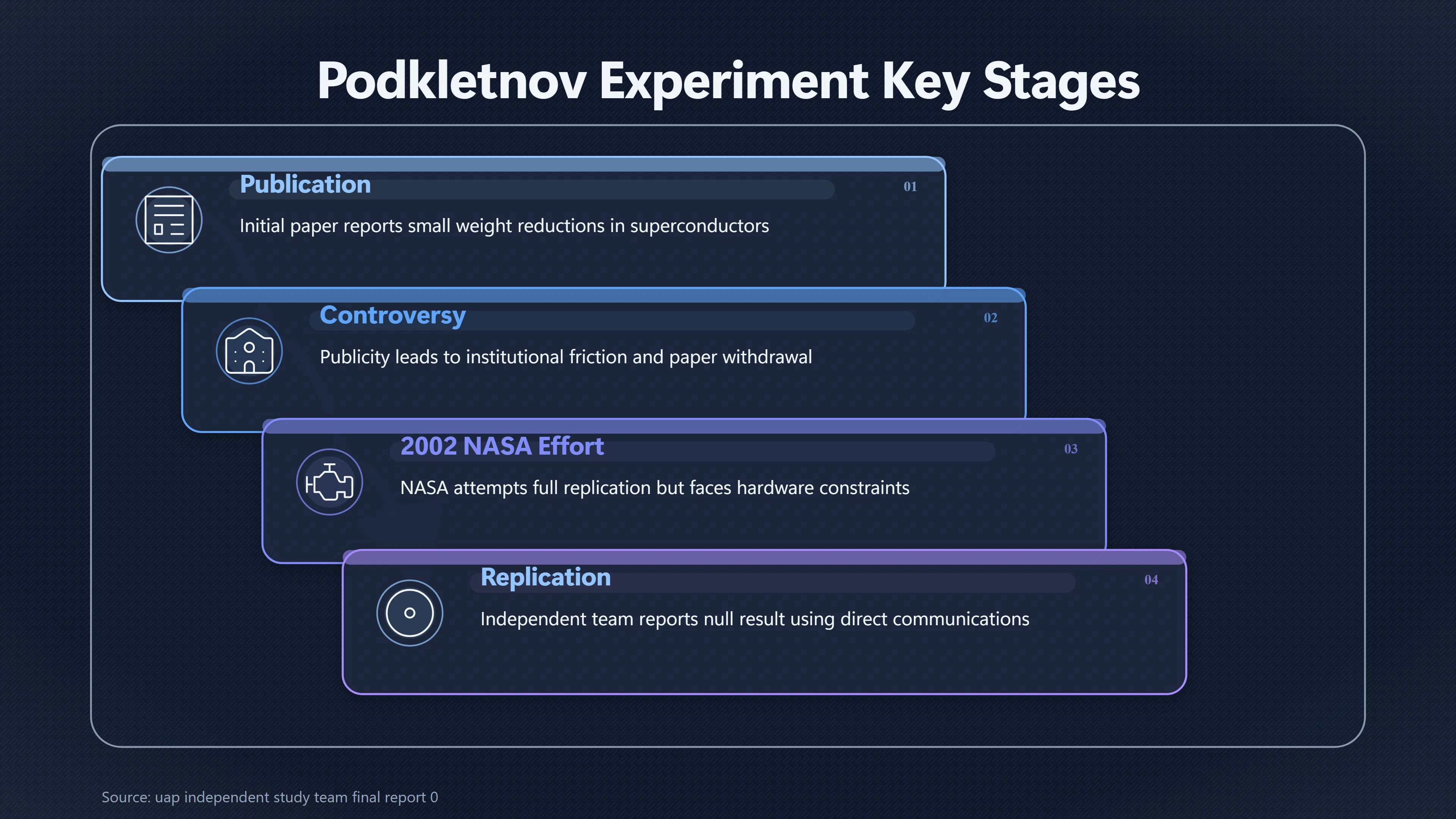
Eugene Podkletnov’s rotating-superconductor experiment is often presented as a case in which an extraordinary antigravity result was buried after institutional hostility. There is a genuine episode of professional controversy behind that interpretation: publicity around the claim damaged Podkletnov’s standing at Tampere, a follow-up paper was withdrawn, and the episode acquired the familiar features of a suppression story. Yet the subsequent experimental record points in a different direction. NASA and other researchers did not simply dismiss the claim. They spent years investigating superconductors, rotating magnetic fields and possible gravity-like effects, while independent experimenters attempted increasingly direct replications.[WIRED]wired.comOpen source on wired.com.
The important distinction is between failure to complete one ambitious NASA replication and suppression of the experiment itself. NASA Marshall Space Flight Center did encounter serious fabrication and resource problems. But a later, privately funded replication based on Podkletnov’s published descriptions and personal communications was completed and reported a null result. NASA’s own retrospective assessment consequently classified the rotating, radio-frequency-driven superconductor approach as non-viable. That sequence provides a useful test case for distinguishing institutional friction from evidence of deliberate concealment.[ResearchGate]researchgate.netOpen source on researchgate.net.
Why NASA took the claim seriously
Podkletnov and co-author R. Nieminen’s original 1992 paper in Physica C reported that small objects suspended above a superconducting yttrium-barium-copper-oxide (YBCO) disc appeared to lose roughly 0.05–0.3 per cent of their weight, with the reported effect depending on the disc’s rotation. A later Podkletnov account claimed substantially larger reductions, reaching roughly 2 per cent under particular operating conditions.[ScienceDirect]sciencedirect.comOpen source on sciencedirect.com.
Such a result would have been revolutionary if reproducible. It would suggest an experimentally accessible connection between superconductivity, electromagnetism and gravity, with obvious implications for propulsion. Rather than treating the proposition as categorically unworthy of investigation, researchers associated with NASA’s Marshall Space Flight Center conducted several relevant experiments during the 1990s. NASA’s technical archive preserves that work openly.[NASA Technical Reports Server]nasa.govOpen source on nasa.gov.
One 1997 experiment by Ning Li, David Noever, Tony Robertson, Ron Koczor and Whitt Brantley examined a simpler, stationary configuration. Using a sensitive gravimeter with levitated bulk YBCO superconductors, the researchers found any change in gravitational acceleration to be below two parts in 100 million of ordinary gravity. That did not reproduce Podkletnov’s rotating experiment exactly, so it could not by itself settle the matter. It did, however, place a strong limit on gravity-like effects from a stationary superconductor.[NASA Technical Reports Server]nasa.govOpen source on nasa.gov.
A subsequent Marshall experiment moved closer to the rotating-field aspect. Large YBCO discs were placed in a three-phase AC motor stator producing a rotating magnetic field. Researchers reported no detectable effect attributable to the rotating magnetic field, thermal conditions or rotation of the superconducting disc within their measurement precision.[NASA Technical Reports Server]nasa.govOpen source on nasa.gov.
These experiments are difficult to reconcile with a simple narrative in which NASA refused to investigate Podkletnov because the subject was too threatening. The institutional record instead shows scientists testing progressively relevant pieces of an unconventional claim and publishing the resulting limits.
Why NASA’s full replication was never completed
The strongest argument for caution about the early null experiments is technical rather than conspiratorial: Podkletnov’s apparatus was unusually difficult to reproduce.
His reported effect depended not merely on possessing some superconducting material. The proposed configuration involved a large, specially manufactured YBCO ceramic disc, cryogenic operation, magnetic levitation or suspension, electromagnetic excitation and rotation. Material structure and fabrication therefore became part of the replication problem. NASA-related work from the period explicitly discussed the difficulty of producing large, durable superconducting discs suitable for these experiments.[NASA Technical Reports Server]nasa.govOpen source on nasa.gov.
That matters because a failed experiment is decisive only to the extent that it tests the conditions under which the original effect was claimed. Researchers themselves recognised this problem. The 2001 University of Sheffield study by R. C. Woods and colleagues examined reported gravity modifications involving high-temperature superconductors but did not reproduce the claimed weight changes; later discussion of the work noted differences between available discs and the conditions specified in Podkletnov’s reports.[ResearchGate]researchgate.netOpen source on researchgate.net.
NASA’s clearest retrospective account came from Marc Millis, who managed its Breakthrough Propulsion Physics project. In a 2004 NASA technical memorandum reviewing speculative propulsion concepts, Millis wrote that Marshall had attempted a full replication of the Podkletnov configuration from 1995 to 2002, but “was not able to complete the test hardware with the available resources”.[ResearchGate]researchgate.netOpen source on researchgate.net.
That sentence is sometimes read as evidence that the experiment was stopped before it could succeed. It establishes something much narrower: the intended full NASA apparatus was not finished because the necessary hardware could not be completed with the resources available.
There is an important institutional context. NASA’s Breakthrough Propulsion Physics project was deliberately designed to investigate highly speculative concepts through relatively inexpensive experiments capable of separating promising leads from dead ends. Its remit included possible manipulation of gravitational or inertial forces, but its resources were finite. Millis reported that the programme ran from 1996 to 2002 and assessed numerous unconventional ideas, some of which were rejected, some left unresolved and some considered worthy of further work.[NASA Technical Reports Server]nasa.govOpen source on nasa.gov.
In that setting, failure to finish an exceptionally difficult experimental rig does not require an extraordinary explanation. It is consistent with the ordinary constraint that speculative research programmes cannot indefinitely pursue every technically demanding anomaly.
The completed replication changes the picture
If the historical record ended with NASA’s unfinished apparatus, suppression arguments would have more room to operate. They could reasonably point out that the most faithful government replication had never reached a definitive experimental test.
But the record did not end there.
George Hathaway, Blair Cleveland and Y. Bao subsequently constructed an apparatus specifically intended to replicate Podkletnov’s reported rotating-superconductor effect. Their experiment drew not only on the published descriptions but also on personal communications with Podkletnov, reducing one important source of uncertainty about what the original experiment required. Their paper appeared in Physica C in 2003.[ScienceDirect]sciencedirect.comOpen source on sciencedirect.com.
The result was negative. The authors reported that they found “no evidence of a gravity-like force” within the sensitivity of their apparatus.[ScienceDirect]sciencedirect.comOpen source on sciencedirect.com.
NASA’s Millis review gave the result additional significance. It stated that the Hathaway team’s measurement sensitivity was about 50 times better than that available to Podkletnov and concluded that the rotating, radio-frequency-pumped superconducting approach should therefore be regarded as non-viable.[NASA Technical Reports Server]nasa.govOpen source on nasa.gov.
That does not logically prove that every possible variation of Podkletnov’s apparatus can produce no anomaly. Replication disputes can always focus on differences in disc manufacture, electromagnetic frequency, rotational speed, geometry or operating sequence. Indeed, those differences have continued to be discussed in the specialist literature.[ResearchGate]researchgate.netOpen source on researchgate.net.
But there is a critical difference between saying “this was not an absolutely identical reconstruction” and saying “the experiment was prevented from being tested”. The latter is difficult to sustain once multiple groups built relevant apparatus, published null measurements and, in Hathaway’s case, incorporated information supplied directly by Podkletnov.
The Tampere controversy was real but proves something different
The suppression interpretation does have a historical event to build upon. Podkletnov’s relationship with his academic environment deteriorated dramatically after the antigravity story became public.
The original 1992 Physica C paper had already appeared in the conventional scientific literature. In 1996, however, a much more dramatic follow-up claim attracted press attention before publication. Reporting at the time described a superconducting ring rotating at thousands of revolutions per minute and a claimed weight reduction approaching 2 per cent. The paper had been submitted to Journal of Physics D: Applied Physics.[ScienceDirect]sciencedirect.comOpen source on sciencedirect.com.
The resulting publicity created a dispute at Tampere. Contemporary accounts describe the institute distancing itself from the antigravity interpretation, while a named co-author disputed his involvement. Podkletnov subsequently withdrew the paper. In a later Wired investigation, journalist Charles Platt described Podkletnov as believing that irresponsible publicity had damaged his career; the article also reported that he lost his university position.[WIRED]wired.comOpen source on wired.com.
This is meaningful evidence of professional and institutional fallout. It belongs in any fair assessment of the case. An unconventional researcher can face reputational damage even when the underlying scientific question has not yet been adequately tested.
What it does not establish is that institutions subsequently prevented independent evaluation of the claimed phenomenon. The years following the controversy produced precisely the activity a physical-suppression hypothesis would have to explain away: NASA research, peer-reviewed experiments, conference papers, specialised superconducting hardware and an eventual direct replication attempt published in the same journal that had carried the original 1992 result.[nasa.gov]nasa.govOpen source on nasa.gov.
The distinction is especially important in discussions of alleged suppression of antigravity researchers. Career hostility can be genuine without the experimental result being genuine. Conversely, demonstrating unfair treatment of a scientist does not demonstrate that the scientist’s disputed physical effect was successfully reproduced.
Null results did not come from one institution
The evidential picture also becomes stronger when NASA is removed from the centre of the story.
C. S. Unnikrishnan published an analysis and experimental investigation in Physica C in 1996. He argued that the reported observations contained difficulties inconsistent with straightforward gravitational shielding, and his preliminary static experiments found no evidence for the claimed effect.[ScienceDirect]sciencedirect.comOpen source on sciencedirect.com.
The Sheffield group later conducted experiments specifically concerned with gravity modification by high-temperature superconductors. Their 2001 work likewise failed to detect the reported changes in test-mass weight, although the researchers acknowledged that their apparatus did not reproduce every feature claimed to be necessary in Podkletnov’s configuration.[ヒロコ財団]or.jpOpen source on or.jp.
Hathaway, Cleveland and Bao then provided the more consequential rotating-superconductor test in 2003 and again obtained a null result.[ScienceDirect]sciencedirect.comOpen source on sciencedirect.com.
Later researchers have continued investigating possible interactions between superconductors and gravity-like anomalies, which itself indicates that the subject was not simply prohibited. A 2022 review of macroscopic quantum systems and gravity, for example, openly cites the Li/Noever NASA work, the Woods experiment and the Hathaway replication as part of the experimental history.[Frontiers]frontiersin.orgOpen source on frontiersin.org.
There are still occasional positive claims. A 2022 preprint by A. V. Fetisov reported weight anomalies involving YBCO material and described them as possible new evidence related to the Podkletnov effect. But its apparatus did not reproduce the defining rotating superconducting-disc configuration: the YBCO was neither superconducting nor rotating. It therefore represents a new anomalous claim requiring independent confirmation rather than a replication that overturns the earlier null results.[arXiv]arxiv.orgOpen source on arxiv.org.

What the replication record says about suppression
Podkletnov’s case illustrates why three propositions that sound similar should be kept separate.
First, Podkletnov experienced serious professional controversy. The withdrawal of his follow-up paper and breakdown of his relationship with Tampere provide legitimate grounds for examining the role of stigma and institutional reputation in unconventional research.[WIRED]wired.comOpen source on wired.com.
Second, NASA’s intended full replication was not completed. That is also documented. The agency’s retrospective account explicitly attributes the outcome to inability to complete the hardware with available resources, after a multi-year effort. Treating the unfinished experiment as though NASA successfully reproduced the effect and then concealed it goes beyond what the document says.[ResearchGate]researchgate.netOpen source on researchgate.net.
Third, the central experimental claim was nevertheless tested elsewhere and failed to reproduce. The 2003 Hathaway experiment is particularly important because it used Podkletnov’s publications plus direct communication with him and reported no detectable gravity-like force. NASA subsequently cited that result in deciding that this particular propulsion approach was not viable.[ScienceDirect]sciencedirect.comOpen source on sciencedirect.com.
This combination makes the case unusually useful when assessing claims of institutional suppression. A research programme can simultaneously contain scepticism, reputational pressure, funding limits, difficult engineering and sincere attempts at replication. None of those conditions requires a hidden programme to suppress a successful discovery.
Why an unfinished experiment can look like a cover-up
The Podkletnov story contains several ingredients that naturally encourage a suppression interpretation: an extraordinary result, hostile publicity, a withdrawn paper, loss of an academic position, expensive specialist hardware and a major government agency that spent years trying but failed to complete its preferred replication apparatus.
Taken separately, those facts can produce a compelling narrative. Taken chronologically, however, they tell a less mysterious story.
The original claim was published rather than censored. Independent scientists criticised and tested it. NASA scientists conducted related experiments and publicly archived their results. Marshall tried to develop increasingly appropriate hardware but ran into fabrication and resource limitations. Another research team then completed a substantial replication and obtained a result incompatible with the reported gravity-like force at its measurement sensitivity. NASA publicly incorporated that null result into its assessment of speculative propulsion concepts.[sciencedirect.com]sciencedirect.comOpen source on sciencedirect.com.
There remains room for a narrower criticism: because reproducing an elaborate experimental system perfectly is difficult, no single null experiment can establish that every conceivable version of the Podkletnov configuration is impossible. That is a normal limitation of experimental inference. It becomes increasingly significant, however, that decades after the original publication there is still no robust, independently reproducible rotating-superconductor gravity-shielding effect comparable with Podkletnov’s reported result. Even NASA’s public-facing scientific material eventually characterised the claim as highly suspect specifically because independent replication had failed.[Cosmicopia]nasa.govOpen source on nasa.gov.
Within the wider history of alleged hostility towards UFO and antigravity researchers, the Podkletnov episode therefore supports a more restrained conclusion than a physical-suppression narrative. The evidence can support claims of stigma, professional damage and constrained resources. It also documents a NASA replication effort that never reached its intended final form. But those facts have to be weighed alongside something stronger than institutional assurances: multiple publicly documented experiments and a completed independent replication that did not reproduce the claimed gravity-like force.
For this particular case, technical failure and the difficulty of reproducing an extraordinary experiment provide a substantially better-supported explanation of the scientific outcome than deliberate institutional suppression.
Amazon book picks
Further Reading
Books and field guides related to Did Podkletnov's Antigravity Claim Fail or Get Suppressed?. Use these as the next step if you want deeper reading beyond the article.
The Antigravity Enigma: Fiction, Fringe Science, and Modern P...
From magic carpets to hoverboards and space drives, the human imagination has always seen antigravity as the ultimate aspirational symbol...
Bad Science
Rating: 5.0/5 from 5 Google Books ratings
Have you ever wondered how one day the media can assert that alcohol is bad for us and the next unashamedly run a story touting the benef...
Superconductivity: A Very Short Introduction
Superconductivity is one of the most exciting areas of research in physics today. Outlining the history of its discovery, and the race to...
The Demon-Haunted World: Science as a Candle in the Dark
Are we on the brink of a new Dark Age of irrationality and superstition? In this book, the writer shows how scientific thinking is necess...
eBay marketplace picks
Marketplace Samples
Live-tested eBay searches with available results related to this page.
Selected fromantigravity poster oneBay.co.uk.




Endnotes
1.
Source: nasa.gov
Title: uap independent study team final report 0
Link:https://www.nasa.gov/wp-content/uploads/2023/09/uap-independent-study-team-final-report-0.pdf?emrc=66f0247c15428
Additional References
2.
Source: youtube.com
Title: Eugene Podkletnov on Gravitational Shielding in Rotating Superconductors
Link:https://www.youtube.com/watch?v=blXEtLPVE9g
Source snippet
APEC 8/28, Part #4 - Glen "Tony" Robertson - NASA Superconductor Gravity Team...
3.
Source: youtube.com
Title: APEC 8/28, Part #4
Link:https://www.youtube.com/watch?v=PJONyLHQ8Oc
Source snippet
Superconductors & Gravity Control | Gary Stephenson...
4.
Source: youtube.com
Title: Superconductors & Gravity Control | Gary Stephenson
Link:https://www.youtube.com/watch?v=msrhrssRmCE
Source snippet
Gravity Control Experiments | George Hathaway...
5.
Source: youtube.com
Title: Gravity Control Experiments | George Hathaway
Link:https://www.youtube.com/watch?v=UfyBY0suoX0
Source snippet
Martin Tajmar on Experimental Gravitomagnetic Research...
6.
Source: lib.arizona.edu
Link:https://lib.arizona.edu/special-collections/collections/james-e-mcdonald-papers
7.
Source: youtube.com
Title: Martin Tajmar on Experimental Gravitomagnetic Research
Link:https://www.youtube.com/watch?v=c6kNAeFWzkA
8.
Source: cia.gov
Title: DOC 0005517742
Link:https://www.cia.gov/readingroom/docs/DOC_0005517742.pdf
9.
Source: project1947.com
Link:https://www.project1947.com/shg/condon/s5chap02.html